Pacinian corpuscle
Pacinian corpuscles (or Lamellar corpuscles) are one of the four major types of mechanoreceptor. They are nerve endings in the skin responsible for sensitivity to vibration and pressure. Vibrational role specifically helps detect surface texture, e.g., rough vs. smooth. Pacinian corpuscles are the most obvious as they form large structures (up to 1 mm long), easiest to see in routine histology.
Structure[edit]
Pacinian corpuscles are oval-shaped and approximately 1 mm in length. The corpuscle is layered like an onion; each layer is a thin, flat Schwann cell. Inside the corpuscle, there is a non-myelinated terminal axon.
Function[edit]
Pacinian corpuscles detect gross pressure changes and vibrations. Any deformation in the corpuscle causes action potentials to be generated, by deforming the neuronal membrane and causing sodium ion channels to open up.
Clinical significance[edit]
Pacinian corpuscles cause action potentials when the skin is rapidly indented but not when the pressure is steady, due to the layers of connective tissue that cover the nerve ending. It is thought that they respond to high velocity changes in joint position.
See also[edit]
References[edit]

-
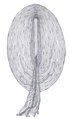 Pacinian corpuscle diagram from Gray's Anatomy
 -
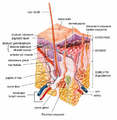 Diagram of human skin showing various structures
 -
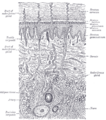 Cross-section of skin with Pacinian corpuscle
 -
 Vater-Pacini corpuscle illustration
 -
 Microscopic image of a Pacinian corpuscle
 -
 Histological image of a Pacinian corpuscle


Medical Disclaimer: WikiMD is for informational purposes only and is not a substitute for professional medical advice. Content may be inaccurate or outdated and should not be used for diagnosis or treatment. Always consult your healthcare provider for medical decisions. Verify information with trusted sources such as CDC.gov and NIH.gov. By using this site, you agree that WikiMD is not liable for any outcomes related to its content. See full disclaimer.
Credits:Most images are courtesy of Wikimedia commons, and templates, categories Wikipedia, licensed under CC BY SA or similar.
Translate this page: - East Asian
中文,
日本,
한국어,
South Asian
हिन्दी,
தமிழ்,
తెలుగు,
Urdu,
ಕನ್ನಡ,
Southeast Asian
Indonesian,
Vietnamese,
Thai,
မြန်မာဘာသာ,
বাংলা
European
español,
Deutsch,
français,
Greek,
português do Brasil,
polski,
română,
русский,
Nederlands,
norsk,
svenska,
suomi,
Italian
Middle Eastern & African
عربى,
Turkish,
Persian,
Hebrew,
Afrikaans,
isiZulu,
Kiswahili,
Other
Bulgarian,
Hungarian,
Czech,
Swedish,
മലയാളം,
मराठी,
ਪੰਜਾਬੀ,
ગુજરાતી,
Portuguese,
Ukrainian

