Pharmacokinetics of testosterone
The Pharmacokinetics of Testosterone refers to the changes that occur to the hormone testosterone in the body, including its absorption, distribution, metabolism, and excretion. Testosterone is a primary male sex hormone and anabolic steroid that plays key roles in the development of male reproductive tissues and the promotion of secondary sexual characteristics.
Absorption[edit]
Testosterone is typically administered through intramuscular injections, transdermal patches, or gels. The absorption rate of testosterone varies depending on the route of administration. Intramuscular injections result in a rapid increase in blood testosterone levels, while transdermal patches and gels provide a more gradual increase.
Distribution[edit]
Once absorbed, testosterone is distributed throughout the body. It is primarily bound to sex hormone-binding globulin (SHBG) and Albumin, with a small fraction remaining free or unbound. The distribution of testosterone is influenced by factors such as age, sex, and overall health status.
Metabolism[edit]
Testosterone is metabolized in the liver by Cytochrome P450 enzymes, primarily into dihydrotestosterone (DHT) and Estradiol, which have their own biological effects. The metabolism of testosterone is also influenced by factors such as age, sex, and the presence of certain diseases or conditions.
Excretion[edit]
Testosterone and its metabolites are excreted from the body in urine and feces. The rate of excretion can be influenced by factors such as age, sex, and overall health status.
Factors Affecting Pharmacokinetics[edit]
Several factors can affect the pharmacokinetics of testosterone, including age, sex, body mass, liver and kidney function, and the presence of certain diseases or conditions. For example, aging is associated with a decrease in testosterone production and an increase in SHBG levels, which can affect the distribution and metabolism of testosterone.
See Also[edit]
 | This endocrinology article is a stub. You can help WikiMD by expanding the page. |

-
 Pharmacokinetics of testosterone
 -
 Testosterone levels with rectal administration of a 40 mg testosterone suppository in men
 -
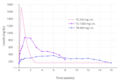 Testosterone levels with intramuscular injection of testosterone esters in hypogonadal men


Medical Disclaimer: WikiMD is for informational purposes only and is not a substitute for professional medical advice. Content may be inaccurate or outdated and should not be used for diagnosis or treatment. Always consult your healthcare provider for medical decisions. Verify information with trusted sources such as CDC.gov and NIH.gov. By using this site, you agree that WikiMD is not liable for any outcomes related to its content. See full disclaimer.
Credits:Most images are courtesy of Wikimedia commons, and templates, categories Wikipedia, licensed under CC BY SA or similar.
Translate page: - East Asian
中文,
日本,
한국어,
South Asian
हिन्दी,
தமிழ்,
తెలుగు,
Urdu,
ಕನ್ನಡ,
Southeast Asian
Indonesian,
Vietnamese,
Thai,
မြန်မာဘာသာ,
বাংলা
European
español,
Deutsch,
français,
Greek,
português do Brasil,
polski,
română,
русский,
Nederlands,
norsk,
svenska,
suomi,
Italian
Middle Eastern & African
عربى,
Turkish,
Persian,
Hebrew,
Afrikaans,
isiZulu,
Kiswahili,
Other
Bulgarian,
Hungarian,
Czech,
Swedish,
മലയാളം,
मराठी,
ਪੰਜਾਬੀ,
ગુજરાતી,
Portuguese,
Ukrainian

