Oligosaccharide
Oligosaccharides are a type of carbohydrate formed by the combination of three to ten simple sugars, or monosaccharides. They are commonly found in plants and milk products and play a crucial role in various biological functions.
Structure[edit]
Oligosaccharides are composed of three to ten monosaccharide residues, which are linked together by glycosidic bonds. The structure of an oligosaccharide can be linear or branched, depending on the type of glycosidic bonds present.
Types[edit]
There are several types of oligosaccharides, including:
- Disaccharides: These are the simplest form of oligosaccharides and consist of two monosaccharide units. Examples include sucrose, lactose, and maltose.
- Trisaccharides: These consist of three monosaccharide units. An example is raffinose.
- Tetrasaccharides: These consist of four monosaccharide units. An example is stachyose.
Functions[edit]
Oligosaccharides perform several important functions in the body:
- Prebiotic function: Some oligosaccharides, such as fructooligosaccharides and galactooligosaccharides, serve as food for beneficial gut bacteria, promoting their growth and activity.
- Cell recognition and cell signaling: Oligosaccharides attached to proteins and lipids on the cell surface play a crucial role in cell recognition and signaling processes.
- Immune response: Oligosaccharides can modulate the immune response by interacting with specific receptors on immune cells.
See also[edit]

This WikiMD article can only be edited by registered and verified editors. You can log in or register.
-
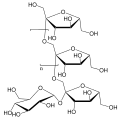 Oligosaccharide
 -
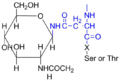 N-Linked Oligosaccharide
 -
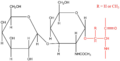 O-Linked Oligosaccharide


Medical Disclaimer: WikiMD is for informational purposes only and is not a substitute for professional medical advice. Content may be inaccurate or outdated and should not be used for diagnosis or treatment. Always consult your healthcare provider for medical decisions. Verify information with trusted sources such as CDC.gov and NIH.gov. By using this site, you agree that WikiMD is not liable for any outcomes related to its content. See full disclaimer.
Credits:Most images are courtesy of Wikimedia commons, and templates, categories Wikipedia, licensed under CC BY SA or similar.
Translate page: - East Asian
中文,
日本,
한국어,
South Asian
हिन्दी,
தமிழ்,
తెలుగు,
Urdu,
ಕನ್ನಡ,
Southeast Asian
Indonesian,
Vietnamese,
Thai,
မြန်မာဘာသာ,
বাংলা
European
español,
Deutsch,
français,
Greek,
português do Brasil,
polski,
română,
русский,
Nederlands,
norsk,
svenska,
suomi,
Italian
Middle Eastern & African
عربى,
Turkish,
Persian,
Hebrew,
Afrikaans,
isiZulu,
Kiswahili,
Other
Bulgarian,
Hungarian,
Czech,
Swedish,
മലയാളം,
मराठी,
ਪੰਜਾਬੀ,
ગુજરાતી,
Portuguese,
Ukrainian

