Octane rating
Octane rating or octane number is a standard measure of the performance of an engine or aviation gasoline. The octane number is a value used to indicate the resistance of a petroleum product to knocking (a rattling noise indicative of self-ignition) in spark-ignition internal combustion engines.
History[edit]
The octane rating system was developed by the chemist Russell Marker. It was introduced in the year 1926. The need for a method to measure the resistance of fuel to knocking was felt due to the development of higher compression engines.
Measurement[edit]
Octane rating is measured relative to a mixture of 2,2,4-trimethylpentane (an isooctane) and heptane. An 87-octane gasoline, for example, performs the same as a blend of 87% isooctane and 13% heptane.
Types of Octane Ratings[edit]
There are different types of octane ratings: Research Octane Number (RON), Motor Octane Number (MON), and Anti-Knock Index (AKI).
Research Octane Number (RON)[edit]
The RON method measures the resistance of a fuel to knocking or pinging during a test in a single-cylinder test engine.
Motor Octane Number (MON)[edit]
The MON testing method uses a similar test engine to that used in RON testing, but with a preheated fuel mixture, higher engine speed, and variable ignition timing to further stress the fuel's knock resistance.
Anti-Knock Index (AKI)[edit]
In most countries, including Australia, New Zealand and all of those in Europe, the "headline" octane rating shown on the pump is the RON, but in Canada, the United States, Brazil, and some other countries, the headline number is the average of the RON and the MON, called the Anti-Knock Index (AKI), and often written on pumps as (R+M)/2.
Importance[edit]
The octane rating of fuel is very important as it directly impacts the fuel efficiency and performance of the engine. Higher octane fuels are used in high performance gasoline engines.
See also[edit]

 | This article about energy, its collection, its distribution, or its uses is a stub. You can help WikiMD by expanding the page. |
 | This automobile-related article is a stub. You can help WikiMD by expanding the page. |
-
 Octane rating standards
 -
 Gas station pump with five octane ratings
 -
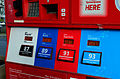 Gas station pump
 -
 100 octane puts our boys on top


Medical Disclaimer: WikiMD is for informational purposes only and is not a substitute for professional medical advice. Content may be inaccurate or outdated and should not be used for diagnosis or treatment. Always consult your healthcare provider for medical decisions. Verify information with trusted sources such as CDC.gov and NIH.gov. By using this site, you agree that WikiMD is not liable for any outcomes related to its content. See full disclaimer.
Credits:Most images are courtesy of Wikimedia commons, and templates, categories Wikipedia, licensed under CC BY SA or similar.
Translate this page: - East Asian
中文,
日本,
한국어,
South Asian
हिन्दी,
தமிழ்,
తెలుగు,
Urdu,
ಕನ್ನಡ,
Southeast Asian
Indonesian,
Vietnamese,
Thai,
မြန်မာဘာသာ,
বাংলা
European
español,
Deutsch,
français,
Greek,
português do Brasil,
polski,
română,
русский,
Nederlands,
norsk,
svenska,
suomi,
Italian
Middle Eastern & African
عربى,
Turkish,
Persian,
Hebrew,
Afrikaans,
isiZulu,
Kiswahili,
Other
Bulgarian,
Hungarian,
Czech,
Swedish,
മലയാളം,
मराठी,
ਪੰਜਾਬੀ,
ગુજરાતી,
Portuguese,
Ukrainian
