Number sign
The number sign (/ˈnʌmbər saɪn/ ), also known as the hash, pound sign, or octothorpe, is a typographical symbol with the appearance of two horizontal lines intersecting two vertical lines. It is represented by the symbol "#" and is used in various contexts across different fields.
History[edit]
The number sign has a rich history, with its origins tracing back to the 14th century. It was initially used as an abbreviation for the Latin term "libra pondo," meaning "pound weight." Over time, the symbol evolved and was adopted in various languages and contexts.
Usage[edit]
Mathematics[edit]
In mathematics, the number sign is occasionally used to denote a number, especially in informal contexts. For example, "#5" can be read as "number five."
Computing[edit]
In computing, the number sign is widely used as a comment symbol in many programming languages, such as Python and Perl. It is also used in URLs and as a delimiter in various data formats.
Social Media[edit]
The number sign gained significant popularity with the advent of social media, where it is used as a "hashtag." A hashtag is a word or phrase preceded by the number sign, used to categorize content and facilitate searches. For example, "#healthcare" might be used to tag posts related to healthcare topics.
Telecommunications[edit]
In telecommunications, the number sign is used on telephone keypads and is often referred to as the "pound key." It is used in various dialing sequences and as a control character in voicemail systems.
Music[edit]
In music, the number sign is sometimes used to denote a sharp note, although the official symbol for a sharp is different (♯).
Cultural Variations[edit]
The number sign is known by different names in various English-speaking countries. In the United States, it is commonly referred to as the "pound sign," while in the United Kingdom and other Commonwealth countries, it is often called the "hash."
Also see[edit]
| Typography | ||||||||||||||||||||||
|---|---|---|---|---|---|---|---|---|---|---|---|---|---|---|---|---|---|---|---|---|---|---|
* Category
|
-
 Pfund
Pfund -
 Libra pondo abbreviation newton
 -
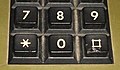 Detail Tastatur FeTAp 751 1982


Medical Disclaimer: WikiMD is for informational purposes only and is not a substitute for professional medical advice. Content may be inaccurate or outdated and should not be used for diagnosis or treatment. Always consult your healthcare provider for medical decisions. Verify information with trusted sources such as CDC.gov and NIH.gov. By using this site, you agree that WikiMD is not liable for any outcomes related to its content. See full disclaimer.
Credits:Most images are courtesy of Wikimedia commons, and templates, categories Wikipedia, licensed under CC BY SA or similar.
Translate page: - East Asian
中文,
日本,
한국어,
South Asian
हिन्दी,
தமிழ்,
తెలుగు,
Urdu,
ಕನ್ನಡ,
Southeast Asian
Indonesian,
Vietnamese,
Thai,
မြန်မာဘာသာ,
বাংলা
European
español,
Deutsch,
français,
Greek,
português do Brasil,
polski,
română,
русский,
Nederlands,
norsk,
svenska,
suomi,
Italian
Middle Eastern & African
عربى,
Turkish,
Persian,
Hebrew,
Afrikaans,
isiZulu,
Kiswahili,
Other
Bulgarian,
Hungarian,
Czech,
Swedish,
മലയാളം,
मराठी,
ਪੰਜਾਬੀ,
ગુજરાતી,
Portuguese,
Ukrainian

