Nuclear triad
Nuclear Triad
The Nuclear Triad refers to the three components of atomic weapons delivery systems: strategic bombers, intercontinental ballistic missiles (ICBMs), and submarine-launched ballistic missiles (SLBMs). The purpose of having this triad is to significantly reduce the possibility that an enemy could destroy all of a nation's nuclear forces in a first-strike attack; this, in turn, ensures a credible threat of a second strike, and thus increases a nation's nuclear deterrence.
Strategic Bombers[edit]
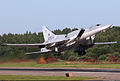
Strategic bombers are large aircraft capable of delivering nuclear weapons. They are a key component of the nuclear triad due to their ability to deliver large payloads over long distances. Strategic bombers include aircraft such as the B-52 Stratofortress, B-2 Spirit, and the Tu-95.
Intercontinental Ballistic Missiles[edit]
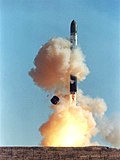
Intercontinental ballistic missiles (ICBMs) are guided ballistic missiles with a minimum range of 5,500 kilometers. They are primarily designed for nuclear weapons delivery. ICBMs have the advantage of being able to deliver a nuclear strike anywhere in the world within a short period of time.
Submarine-Launched Ballistic Missiles[edit]
Submarine-launched ballistic missiles (SLBMs) are ballistic missiles which are launched from submarines. They provide a highly survivable and virtually undetectable nuclear deterrent, as they can be hidden in the vastness of the world's oceans.
Nuclear Deterrence[edit]
The concept of nuclear deterrence is central to understanding the purpose of the nuclear triad. The idea is to deter an enemy from attacking by promising a retaliatory second strike. The nuclear triad ensures that even if a first strike destroys one or two components of the triad, the remaining component(s) would be capable of a retaliatory strike.
See Also[edit]
 | This military-related article is a stub. You can help WikiMD by expanding the page. |
-
 Nuclear triad
 -
 Nuclear triad
 -
 Nuclear triad
 -
 Nuclear triad
 -
 Nuclear triad
 -
 Nuclear triad
 -
 Nuclear triad
 -
 Nuclear triad
 -
 Nuclear triad
 -
 Nuclear triad
 -
 Nuclear triad
 -
 Nuclear triad


_Class_Ballistic_Missile_Submarine.JPG)


.jpg)


_underway_at_sea,_circa_in_the_1970s.jpg)
Medical Disclaimer: WikiMD is for informational purposes only and is not a substitute for professional medical advice. Content may be inaccurate or outdated and should not be used for diagnosis or treatment. Always consult your healthcare provider for medical decisions. Verify information with trusted sources such as CDC.gov and NIH.gov. By using this site, you agree that WikiMD is not liable for any outcomes related to its content. See full disclaimer.
Credits:Most images are courtesy of Wikimedia commons, and templates, categories Wikipedia, licensed under CC BY SA or similar.
Translate this page: - East Asian
中文,
日本,
한국어,
South Asian
हिन्दी,
தமிழ்,
తెలుగు,
Urdu,
ಕನ್ನಡ,
Southeast Asian
Indonesian,
Vietnamese,
Thai,
မြန်မာဘာသာ,
বাংলা
European
español,
Deutsch,
français,
Greek,
português do Brasil,
polski,
română,
русский,
Nederlands,
norsk,
svenska,
suomi,
Italian
Middle Eastern & African
عربى,
Turkish,
Persian,
Hebrew,
Afrikaans,
isiZulu,
Kiswahili,
Other
Bulgarian,
Hungarian,
Czech,
Swedish,
മലയാളം,
मराठी,
ਪੰਜਾਬੀ,
ગુજરાતી,
Portuguese,
Ukrainian
