Neil Hamilton Fairley
Neil Hamilton Fairley (15 July 1891 – 19 April 1966) was an Australian physician and pathologist who made significant contributions to the field of tropical medicine. He is best known for his research on malaria, which played a crucial role in the health of troops during World War II.
Early life and education[edit]
Fairley was born in Inglewood, Victoria, Australia. He attended Scotch College in Melbourne and later studied medicine at the University of Melbourne. After graduating in 1915, he joined the Australian Army Medical Corps and served in World War I.
Career[edit]
After the war, Fairley worked at the London School of Hygiene & Tropical Medicine, where he conducted research on tropical diseases. His work on malaria, in particular, was groundbreaking. He discovered that the disease could be controlled by treating the patient with quinine, a drug that kills the malaria parasite.
During World War II, Fairley's research was instrumental in protecting troops in the Pacific and North Africa. His work saved countless lives and earned him international recognition.
Legacy[edit]
Fairley's contributions to medicine have been widely recognized. He was knighted in 1944 for his services to medicine and the war effort. The Neil Hamilton Fairley Medal, awarded by the Royal Australasian College of Physicians, is named in his honour.
See also[edit]
References[edit]
External links[edit]
 | This medical article is a stub. You can help WikiMD by expanding the page. |
-
 Neil Hamilton Fairley
 -
 Officers of Number 14 Australian General Hospital, Cairo, Egypt, c. 1917
 -
 HQ I Corps
 -
 Cairns
 -
 Atherton Conference
 -
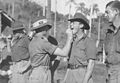 Atebrin Parade
 -
 Neil Hamilton Fairley, 1956


Medical Disclaimer: WikiMD is for informational purposes only and is not a substitute for professional medical advice. Content may be inaccurate or outdated and should not be used for diagnosis or treatment. Always consult your healthcare provider for medical decisions. Verify information with trusted sources such as CDC.gov and NIH.gov. By using this site, you agree that WikiMD is not liable for any outcomes related to its content. See full disclaimer.
Credits:Most images are courtesy of Wikimedia commons, and templates, categories Wikipedia, licensed under CC BY SA or similar.
Translate page: - East Asian
中文,
日本,
한국어,
South Asian
हिन्दी,
தமிழ்,
తెలుగు,
Urdu,
ಕನ್ನಡ,
Southeast Asian
Indonesian,
Vietnamese,
Thai,
မြန်မာဘာသာ,
বাংলা
European
español,
Deutsch,
français,
Greek,
português do Brasil,
polski,
română,
русский,
Nederlands,
norsk,
svenska,
suomi,
Italian
Middle Eastern & African
عربى,
Turkish,
Persian,
Hebrew,
Afrikaans,
isiZulu,
Kiswahili,
Other
Bulgarian,
Hungarian,
Czech,
Swedish,
മലയാളം,
मराठी,
ਪੰਜਾਬੀ,
ગુજરાતી,
Portuguese,
Ukrainian

