Negative room pressure
Negative room pressure is an environmental control measure used in hospitals, laboratories, and other facilities to prevent contamination and the spread of infectious diseases. It involves creating a lower air pressure in one room compared to the surrounding areas, ensuring that air flows into the room rather than out of it. This technique is critical in infection control, especially in isolation rooms where patients with airborne diseases such as tuberculosis, SARS, COVID-19, and influenza are treated.
Overview[edit]
Negative room pressure is achieved by using ventilation systems that remove more air from a room than they allow in. This imbalance in air exchange creates a negative pressure gradient, drawing air into the room whenever the door is opened, rather than allowing potentially contaminated air to escape into adjacent areas. The air that is removed is typically filtered or treated to remove pathogens before being released outside the facility.
Applications[edit]
The primary application of negative room pressure is in healthcare settings, where it is used to isolate patients with airborne infectious diseases. This prevents the spread of pathogens to other parts of the hospital, protecting both healthcare workers and other patients. Negative pressure rooms are also used in:
- Laboratories dealing with hazardous materials
- Pharmaceutical manufacturing facilities
- Biological containment facilities
Design and Operation[edit]
Designing a negative pressure room involves several key components:
- An HVAC system capable of controlling air flow rates to achieve and maintain negative pressure
- HEPA filters or similar filtration systems to clean the air exiting the room
- Monitoring systems to continuously measure the pressure differential between the negative pressure room and adjacent areas
- Sealed rooms to prevent unintended air leaks
Regulations and Standards[edit]
Several organizations provide guidelines and standards for the design and operation of negative pressure rooms, including the Centers for Disease Control and Prevention (CDC) and the World Health Organization (WHO). These guidelines cover aspects such as the minimum air changes per hour (ACH) required to maintain negative pressure, the use of HEPA filtration, and the testing and certification of facilities.
Challenges[edit]
Maintaining negative room pressure poses several challenges, including:
- Ensuring consistent negative pressure, especially in the face of varying external conditions
- Balancing the need for negative pressure with patient comfort, particularly in terms of temperature and humidity
- The cost of installation and operation, including energy consumption and maintenance
Conclusion[edit]
Negative room pressure is a vital tool in the prevention of the spread of infectious diseases within healthcare and research facilities. Its effective implementation requires careful design, ongoing monitoring, and adherence to established guidelines and standards.

This WikiMD article can only be edited by registered and verified editors. You can log in or register.
-
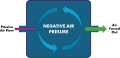 Diagram illustrating negative air pressure
 -
 Inside view of an isolation chamber
 -
 Diagram of a negative pressure room


Medical Disclaimer: WikiMD is for informational purposes only and is not a substitute for professional medical advice. Content may be inaccurate or outdated and should not be used for diagnosis or treatment. Always consult your healthcare provider for medical decisions. Verify information with trusted sources such as CDC.gov and NIH.gov. By using this site, you agree that WikiMD is not liable for any outcomes related to its content. See full disclaimer.
Credits:Most images are courtesy of Wikimedia commons, and templates, categories Wikipedia, licensed under CC BY SA or similar.
Translate page: - East Asian
中文,
日本,
한국어,
South Asian
हिन्दी,
தமிழ்,
తెలుగు,
Urdu,
ಕನ್ನಡ,
Southeast Asian
Indonesian,
Vietnamese,
Thai,
မြန်မာဘာသာ,
বাংলা
European
español,
Deutsch,
français,
Greek,
português do Brasil,
polski,
română,
русский,
Nederlands,
norsk,
svenska,
suomi,
Italian
Middle Eastern & African
عربى,
Turkish,
Persian,
Hebrew,
Afrikaans,
isiZulu,
Kiswahili,
Other
Bulgarian,
Hungarian,
Czech,
Swedish,
മലയാളം,
मराठी,
ਪੰਜਾਬੀ,
ગુજરાતી,
Portuguese,
Ukrainian

