Negative feedback
Negative feedback is a fundamental concept in biology and engineering, where it refers to a mechanism or process that reduces or counteracts the effects of a system output. In other words, negative feedback works to stabilize a system and maintain it within certain limits.
Biology[edit]
In biology, negative feedback mechanisms are essential for maintaining homeostasis. These mechanisms work by reducing the output or activity of any organ or system (back to its normal range of functioning) that has become too high or too low. Examples of negative feedback in biology include the regulation of body temperature, blood glucose levels, and blood pressure.
Engineering[edit]
In engineering, negative feedback is used to stabilize a system and reduce the effects of unwanted changes. This is achieved by feeding back a portion of the system's output to reduce its subsequent output. Negative feedback is used in many systems, including electronic amplifiers, to stabilize the gain.
See also[edit]

This WikiMD article can only be edited by registered and verified editors. You can log in or register.
Negative_feedback[edit]
-
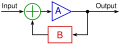 Ideal feedback model
 -
 Negative Feedback Gif
 -
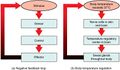 105 Negative Feedback Loops
 -
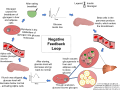 An example of a negative feedback loop is the process of increasing and decreasing glucose levels in our bloodstream
 -
Basic error-controlled regulator
-
Regulator with feedback
-
Negative feedback amplifier with disturbance
-
Feedback op-amp voltage amplifier
-
Ballcock
-
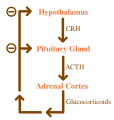 ACTH Negative Feedback
 -
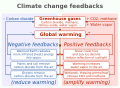 Feedbacks affecting global warming and climate change - block diagram
 -
Centrifugal governor


Medical Disclaimer: WikiMD is for informational purposes only and is not a substitute for professional medical advice. Content may be inaccurate or outdated and should not be used for diagnosis or treatment. Always consult your healthcare provider for medical decisions. Verify information with trusted sources such as CDC.gov and NIH.gov. By using this site, you agree that WikiMD is not liable for any outcomes related to its content. See full disclaimer.
Credits:Most images are courtesy of Wikimedia commons, and templates, categories Wikipedia, licensed under CC BY SA or similar.
Translate page: - East Asian
中文,
日本,
한국어,
South Asian
हिन्दी,
தமிழ்,
తెలుగు,
Urdu,
ಕನ್ನಡ,
Southeast Asian
Indonesian,
Vietnamese,
Thai,
မြန်မာဘာသာ,
বাংলা
European
español,
Deutsch,
français,
Greek,
português do Brasil,
polski,
română,
русский,
Nederlands,
norsk,
svenska,
suomi,
Italian
Middle Eastern & African
عربى,
Turkish,
Persian,
Hebrew,
Afrikaans,
isiZulu,
Kiswahili,
Other
Bulgarian,
Hungarian,
Czech,
Swedish,
മലയാളം,
मराठी,
ਪੰਜਾਬੀ,
ગુજરાતી,
Portuguese,
Ukrainian


