Neanderthal anatomy
Neanderthal Anatomy refers to the physical characteristics and traits of the Neanderthal, an extinct species of archaic humans that lived in Eurasia until about 40,000 years ago. The Neanderthal anatomy is distinct from that of modern humans in several respects, including a more robust build and distinctive morphological features in the skull and postcranial skeleton.
Skull[edit]
The Neanderthal skull is typically more elongated and larger than that of modern humans, with a more pronounced brow ridge and a lack of a prominent chin. The braincase of Neanderthals was also larger than that of modern humans, suggesting a larger brain size.
Postcranial Skeleton[edit]
The postcranial skeleton of Neanderthals was robust, with a wide pelvis and barrel-shaped chest. The limb bones were thick and strong, indicative of a physically demanding lifestyle. Neanderthals also had shorter limbs compared to modern humans, which is thought to be an adaptation to cold climates.
Dentition[edit]
Neanderthal dentition was also distinct, with larger front teeth and a unique wear pattern suggesting that they used their teeth as a third hand for holding objects.
Musculature[edit]
Neanderthals had a more robust musculature than modern humans, with particularly strong arm and leg muscles. This is thought to be an adaptation to their physically demanding lifestyle and cold environment.
Genetic Traits[edit]
Studies of Neanderthal DNA have revealed that they had a number of distinct genetic traits, some of which are still present in modern humans of non-African descent due to interbreeding between Neanderthals and early modern humans.
See Also[edit]
References[edit]
 | This article relating to anthropology is a stub. You can help WikiMD by expanding the page. |
-
Neanderthal anatomy
-
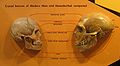 Comparison of Homo sapiens and Neanderthal
 -
Neanderthal cranial anatomy
-
 Neanderthal foot print
 -
Neanderthal child


Medical Disclaimer: WikiMD is for informational purposes only and is not a substitute for professional medical advice. Content may be inaccurate or outdated and should not be used for diagnosis or treatment. Always consult your healthcare provider for medical decisions. Verify information with trusted sources such as CDC.gov and NIH.gov. By using this site, you agree that WikiMD is not liable for any outcomes related to its content. See full disclaimer.
Credits:Most images are courtesy of Wikimedia commons, and templates, categories Wikipedia, licensed under CC BY SA or similar.
Translate page: - East Asian
中文,
日本,
한국어,
South Asian
हिन्दी,
தமிழ்,
తెలుగు,
Urdu,
ಕನ್ನಡ,
Southeast Asian
Indonesian,
Vietnamese,
Thai,
မြန်မာဘာသာ,
বাংলা
European
español,
Deutsch,
français,
Greek,
português do Brasil,
polski,
română,
русский,
Nederlands,
norsk,
svenska,
suomi,
Italian
Middle Eastern & African
عربى,
Turkish,
Persian,
Hebrew,
Afrikaans,
isiZulu,
Kiswahili,
Other
Bulgarian,
Hungarian,
Czech,
Swedish,
മലയാളം,
मराठी,
ਪੰਜਾਬੀ,
ગુજરાતી,
Portuguese,
Ukrainian


.jpg)