Natural reservoir
Natural reservoir or reservoir of infection is the long-term host of the pathogen of an infectious disease. Hosts often do not get the disease carried by the pathogen or it is carried as a subclinical infection and so asymptomatic. The reservoir acts as a source from which others can be infected.
Types of Reservoirs[edit]
There are three types of reservoirs: human, animal, and environmental.
Human Reservoirs[edit]
Human reservoirs are people who are infected with a particular pathogen and can transmit the disease to others. These individuals may be symptomatic, showing signs of the disease, or asymptomatic, showing no signs of the disease.
Animal Reservoirs[edit]
Animal reservoirs are animals that are infected with a particular pathogen and can transmit the disease to humans. This is often seen in zoonotic diseases, which are diseases that can be transmitted from animals to humans.
Environmental Reservoirs[edit]
Environmental reservoirs are physical locations or objects that harbor the pathogen and can transmit the disease to humans. These can include soil, water, and air.
Role in Disease Transmission[edit]
The natural reservoir plays a critical role in the transmission of infectious diseases. The pathogen relies on the reservoir for survival and reproduction. The reservoir also provides a means for the pathogen to be transmitted to new hosts.
Examples of Natural Reservoirs[edit]
Some examples of natural reservoirs include:
- Humans are the natural reservoir for diseases such as HIV and tuberculosis.
- Animals are the natural reservoir for diseases such as rabies and Lyme disease.
- The environment is the natural reservoir for diseases such as Legionnaires' disease and tetanus.
See Also[edit]
References[edit]
 | This medical article is a stub. You can help WikiMD by expanding the page. |
Natural_reservoir[edit]
-
 A portrait of a horned cow in a natural setting.
 -
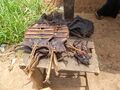 Bushmeat being sold in a market in Ghana.


Medical Disclaimer: WikiMD is for informational purposes only and is not a substitute for professional medical advice. Content may be inaccurate or outdated and should not be used for diagnosis or treatment. Always consult your healthcare provider for medical decisions. Verify information with trusted sources such as CDC.gov and NIH.gov. By using this site, you agree that WikiMD is not liable for any outcomes related to its content. See full disclaimer.
Credits:Most images are courtesy of Wikimedia commons, and templates, categories Wikipedia, licensed under CC BY SA or similar.
Translate page: - East Asian
中文,
日本,
한국어,
South Asian
हिन्दी,
தமிழ்,
తెలుగు,
Urdu,
ಕನ್ನಡ,
Southeast Asian
Indonesian,
Vietnamese,
Thai,
မြန်မာဘာသာ,
বাংলা
European
español,
Deutsch,
français,
Greek,
português do Brasil,
polski,
română,
русский,
Nederlands,
norsk,
svenska,
suomi,
Italian
Middle Eastern & African
عربى,
Turkish,
Persian,
Hebrew,
Afrikaans,
isiZulu,
Kiswahili,
Other
Bulgarian,
Hungarian,
Czech,
Swedish,
മലയാളം,
मराठी,
ਪੰਜਾਬੀ,
ગુજરાતી,
Portuguese,
Ukrainian

