Muscular process of arytenoid cartilage
[[File: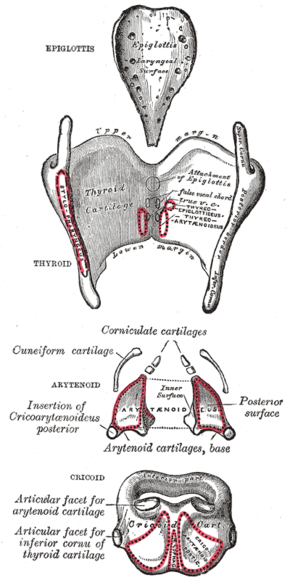 |frameless|alt=]]

| Details | |
|---|---|
| Synonyms | |
| Pronunciation | |
| Carnegie stage | |
| Days | |
| Precursor | |
| Gives rise to | |
| Part of | |
The muscular process of the arytenoid cartilage is a critical anatomical feature of the larynx, playing a vital role in the function of the vocal cords and voice production. The arytenoid cartilages are paired structures located in the larynx, and each has a muscular process that serves as an attachment point for important laryngeal muscles.
Anatomy[edit]
The arytenoid cartilages are pyramid-shaped structures situated on the superior border of the cricoid cartilage. Each arytenoid cartilage has three processes: the vocal process, the apex, and the muscular process. The muscular process projects laterally and serves as the attachment site for the posterior cricoarytenoid muscle and the lateral cricoarytenoid muscle.
Muscles Attached[edit]
- Posterior cricoarytenoid muscle: This muscle is the only abductor of the vocal cords, meaning it opens the vocal cords by rotating the arytenoid cartilages laterally.
- Lateral cricoarytenoid muscle: This muscle adducts the vocal cords, closing them by rotating the arytenoid cartilages medially.
Function[edit]
The muscular process of the arytenoid cartilage is essential for the movement and positioning of the vocal cords. By serving as the attachment point for the posterior and lateral cricoarytenoid muscles, it allows for the precise control of vocal cord tension and position, which is necessary for phonation and breathing.
Clinical Significance[edit]
Dysfunction or damage to the muscular process or the muscles attached to it can lead to voice disorders or breathing difficulties. Conditions such as vocal cord paralysis or arytenoid dislocation can affect the function of the muscular process, impacting the ability to speak or breathe properly.
Also see[edit]
| Anatomy of the lower respiratory tract | ||||||||||||
|---|---|---|---|---|---|---|---|---|---|---|---|---|
|

Medical Disclaimer: WikiMD is for informational purposes only and is not a substitute for professional medical advice. Content may be inaccurate or outdated and should not be used for diagnosis or treatment. Always consult your healthcare provider for medical decisions. Verify information with trusted sources such as CDC.gov and NIH.gov. By using this site, you agree that WikiMD is not liable for any outcomes related to its content. See full disclaimer.
Credits:Most images are courtesy of Wikimedia commons, and templates, categories Wikipedia, licensed under CC BY SA or similar.
Translate page: - East Asian
中文,
日本,
한국어,
South Asian
हिन्दी,
தமிழ்,
తెలుగు,
Urdu,
ಕನ್ನಡ,
Southeast Asian
Indonesian,
Vietnamese,
Thai,
မြန်မာဘာသာ,
বাংলা
European
español,
Deutsch,
français,
Greek,
português do Brasil,
polski,
română,
русский,
Nederlands,
norsk,
svenska,
suomi,
Italian
Middle Eastern & African
عربى,
Turkish,
Persian,
Hebrew,
Afrikaans,
isiZulu,
Kiswahili,
Other
Bulgarian,
Hungarian,
Czech,
Swedish,
മലയാളം,
मराठी,
ਪੰਜਾਬੀ,
ગુજરાતી,
Portuguese,
Ukrainian

