Muscovy duck
Muscovy Duck
The Muscovy Duck (Cairina moschata) is a large duck native to Mexico, Central America, and South America. Small wild and feral breeding populations have established themselves in the United States, particularly in the lower Rio Grande Valley of Texas, as well as in many other parts of North America, including southern Canada. Feral Muscovy Ducks are found in New Zealand, Australia, and in parts of Europe.
Description[edit]
Muscovy Ducks are large ducks, with the males about 76 cm long, and the females about 64 cm. The bird is predominantly black and white, with the back feathers being iridescent and glossy in males, while the females are more drab. The amount of white on the neck and head is variable, as well as the bill, which can be yellow, pink, black, or any mixture of these. They may have white patches or bars on the wings, which become more noticeable during flight. Both sexes have pink or red wattles around the bill, those of the male being larger and more brightly colored.
Behavior[edit]
The Muscovy Duck is a quiet, generally peaceful bird, although males can be aggressive. It tends to be somewhat solitary or forms small flocks. This duck does not migrate, preferring to stay in the same area year-round. It is a strong flier, especially the wild varieties.
Breeding[edit]
Muscovy Ducks breed in woodland habitats along lakes, lagoons, mangrove swamps, marshes, and slow-moving streams, where they nest in tree cavities or on hidden spots on the ground. They lay their eggs in a nest which the female lines with down. The breeding season is variable and may occur in any month of the year, depending on conditions.
Diet[edit]
Muscovy Ducks feed on the roots, stems, leaves, and seeds of aquatic and terrestrial plants, including agricultural crops. They also eat small fish, reptiles, crustaceans, insects, millipedes, and other invertebrates.
Domestication[edit]
The Muscovy Duck has been domesticated for centuries, and domestic ducks are often kept for their meat, eggs, and feathers. They are also kept as pets and for pest control.
Conservation Status[edit]
The wild Muscovy Duck population is widespread and large, and the species is not considered to be threatened. However, habitat loss and hunting can pose a risk to populations in some areas.
See Also[edit]

-
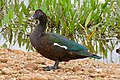 Muscovy Duck (Cairina moschata) male
 -
 Muscovy Duck (Cairina moschata) male
 -
 Muscovy Duck
 -
 Black Duck
 -
 Muscovy drake Graniteville SC USA
 -
 Duck wings outstretched
 -
 Cairina moschata MWNH 1056
 -
 Muscovy duck at Lake Union
_male_(29039391935).jpg)
_male_(48300658492).jpg)

.jpg)


Ad. Transform your life with W8MD's
GLP-1 weight loss injections special from $29.99 with insurance
|
WikiMD Medical Encyclopedia |
Medical Disclaimer: WikiMD is for informational purposes only and is not a substitute for professional medical advice. Content may be inaccurate or outdated and should not be used for diagnosis or treatment. Always consult your healthcare provider for medical decisions. Verify information with trusted sources such as CDC.gov and NIH.gov. By using this site, you agree that WikiMD is not liable for any outcomes related to its content. See full disclaimer.
Credits:Most images are courtesy of Wikimedia commons, and templates, categories Wikipedia, licensed under CC BY SA or similar.
Translate this page: - East Asian
中文,
日本,
한국어,
South Asian
हिन्दी,
தமிழ்,
తెలుగు,
Urdu,
ಕನ್ನಡ,
Southeast Asian
Indonesian,
Vietnamese,
Thai,
မြန်မာဘာသာ,
বাংলা
European
español,
Deutsch,
français,
Greek,
português do Brasil,
polski,
română,
русский,
Nederlands,
norsk,
svenska,
suomi,
Italian
Middle Eastern & African
عربى,
Turkish,
Persian,
Hebrew,
Afrikaans,
isiZulu,
Kiswahili,
Other
Bulgarian,
Hungarian,
Czech,
Swedish,
മലയാളം,
मराठी,
ਪੰਜਾਬੀ,
ગુજરાતી,
Portuguese,
Ukrainian
