Muridae
Muridae is a large family of small to medium-sized rodents, including mice, rats, voles, and gerbils. The family is broad and includes over 700 species that are found naturally throughout Eurasia, Africa, and Australia.
Taxonomy[edit]
The family Muridae is the largest family of rodents and of mammals, containing over 700 species found naturally throughout Eurasia, Africa, and Australia. The name Muridae comes from the Latin mus, meaning 'mouse'.
Characteristics[edit]
Members of the Muridae family are small to medium-sized rodents, varying in size from the 6 cm (2.4 in) Harvest Mouse to the 45 cm (18 in) Rat. They typically have slender bodies with scaled tails and large eyes, and are most commonly nocturnal.
Distribution and habitat[edit]
Muridae species are found throughout Eurasia, Africa, and Australia, and have been introduced to the Americas. They inhabit a wide range of habitats from tropical forests to arid deserts.
Behavior[edit]
Most Muridae are terrestrial animals, although some are arboreal or semi-aquatic. They are often considered pests in many cultures because they can spread diseases and damage crops and stored food.
Reproduction[edit]
Muridae have a short gestation period and can reproduce rapidly. Some species have litters of up to 14 young.
Diet[edit]
Members of the Muridae family are omnivorous, eating a wide range of foods including seeds, fruit, stems, leaves, and insects.
Relationship with humans[edit]
Many Muridae species have a significant impact on human societies, as they can spread diseases and damage crops and stored food. Some species, such as the House Mouse and Brown Rat, are notable pests.
See also[edit]
References[edit]

This WikiMD article can only be edited by registered and verified editors. You can log in or register.
Muridae[edit]
-
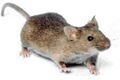 Mouse white background


Medical Disclaimer: WikiMD is for informational purposes only and is not a substitute for professional medical advice. Content may be inaccurate or outdated and should not be used for diagnosis or treatment. Always consult your healthcare provider for medical decisions. Verify information with trusted sources such as CDC.gov and NIH.gov. By using this site, you agree that WikiMD is not liable for any outcomes related to its content. See full disclaimer.
Credits:Most images are courtesy of Wikimedia commons, and templates, categories Wikipedia, licensed under CC BY SA or similar.
Translate page: - East Asian
中文,
日本,
한국어,
South Asian
हिन्दी,
தமிழ்,
తెలుగు,
Urdu,
ಕನ್ನಡ,
Southeast Asian
Indonesian,
Vietnamese,
Thai,
မြန်မာဘာသာ,
বাংলা
European
español,
Deutsch,
français,
Greek,
português do Brasil,
polski,
română,
русский,
Nederlands,
norsk,
svenska,
suomi,
Italian
Middle Eastern & African
عربى,
Turkish,
Persian,
Hebrew,
Afrikaans,
isiZulu,
Kiswahili,
Other
Bulgarian,
Hungarian,
Czech,
Swedish,
മലയാളം,
मराठी,
ਪੰਜਾਬੀ,
ગુજરાતી,
Portuguese,
Ukrainian

