Mixed inhibition

Mixed inhibition refers to a type of enzyme inhibition where the inhibitor can bind to either the enzyme alone or the enzyme-substrate complex, but with different affinity. This form of inhibition is distinct from competitive inhibition, where the inhibitor competes with the substrate for the active site, and non-competitive inhibition, where the inhibitor and substrate can bind simultaneously to the enzyme but only at different sites. Mixed inhibition affects both the affinity of the enzyme for its substrate (Km) and the maximum rate of reaction (Vmax), making it a more complex form of regulation.
Mechanism[edit]
In mixed inhibition, the inhibitor binds to an allosteric site (a site other than the active site) on the enzyme. This binding can occur whether the enzyme has already bound a substrate or not. The effect of this binding varies; it can either increase or decrease the enzyme's affinity for the substrate, depending on the nature of the interaction between the enzyme, substrate, and inhibitor. This results in changes to both Km and Vmax values, which are parameters used to describe the kinetics of enzyme-catalyzed reactions according to the Michaelis-Menten equation.
Kinetics[edit]
The kinetic behavior of mixed inhibition can be analyzed through Lineweaver-Burk plots, which are double reciprocal plots of 1/V against 1/[S] (where V is the reaction velocity and [S] is the substrate concentration). Mixed inhibitors cause the lines in Lineweaver-Burk plots to intersect at a point left from the y-axis, indicating changes in both Km and Vmax. This is in contrast to competitive and non-competitive inhibitors, which show parallel lines and intersecting lines on the y-axis, respectively.
Clinical Significance[edit]
Mixed inhibition has implications in pharmacology and drug design, as understanding the inhibitory mechanisms can lead to the development of drugs that specifically target certain enzymes involved in disease processes. For example, mixed inhibitors can be designed to modulate the activity of enzymes that are overactive in certain conditions, providing a therapeutic benefit.
Examples[edit]
A well-known example of mixed inhibition is the inhibition of cytochrome P450 enzymes by certain drugs. These enzymes play a crucial role in drug metabolism, and their inhibition can lead to increased blood levels of drugs, potentially causing adverse effects.
.svg) | This biochemistry article is a stub. You can help WikiMD by expanding the page. |
Mixed_inhibition[edit]
-
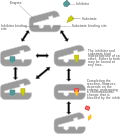 Mixed inhibition
 -
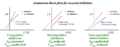 Enzyme Inhibition Lineweaver-Burk plots


Medical Disclaimer: WikiMD is for informational purposes only and is not a substitute for professional medical advice. Content may be inaccurate or outdated and should not be used for diagnosis or treatment. Always consult your healthcare provider for medical decisions. Verify information with trusted sources such as CDC.gov and NIH.gov. By using this site, you agree that WikiMD is not liable for any outcomes related to its content. See full disclaimer.
Credits:Most images are courtesy of Wikimedia commons, and templates, categories Wikipedia, licensed under CC BY SA or similar.
Translate page: - East Asian
中文,
日本,
한국어,
South Asian
हिन्दी,
தமிழ்,
తెలుగు,
Urdu,
ಕನ್ನಡ,
Southeast Asian
Indonesian,
Vietnamese,
Thai,
မြန်မာဘာသာ,
বাংলা
European
español,
Deutsch,
français,
Greek,
português do Brasil,
polski,
română,
русский,
Nederlands,
norsk,
svenska,
suomi,
Italian
Middle Eastern & African
عربى,
Turkish,
Persian,
Hebrew,
Afrikaans,
isiZulu,
Kiswahili,
Other
Bulgarian,
Hungarian,
Czech,
Swedish,
മലയാളം,
मराठी,
ਪੰਜਾਬੀ,
ગુજરાતી,
Portuguese,
Ukrainian

