Mesenteric arteries
Mesenteric arteries are the arteries that supply blood to the digestive system. There are two primary mesenteric arteries: the superior mesenteric artery (SMA) and the inferior mesenteric artery (IMA). These arteries are critical for the functioning of the digestive system, as they provide the oxygen and nutrients necessary for the organs to function.
Etymology[edit]
The term "mesenteric" comes from the Greek words "mesos", meaning middle, and "enteron", meaning intestine. This is because the mesenteric arteries supply blood to the middle part of the intestine.
Superior Mesenteric Artery[edit]
The superior mesenteric artery arises from the anterior surface of the aorta, just below the celiac trunk. It travels inferiorly in the mesentery, supplying blood to the pancreas, small intestine, and part of the large intestine.
Inferior Mesenteric Artery[edit]
The inferior mesenteric artery arises from the anterior surface of the aorta, about 3-4 cm above the bifurcation of the aorta. It supplies blood to the distal part of the large intestine and the rectum.
Clinical Significance[edit]
Blockage or narrowing of the mesenteric arteries can lead to mesenteric ischemia, a serious condition that can cause abdominal pain and potentially life-threatening complications. Treatment typically involves procedures to restore blood flow, such as angioplasty or bypass surgery.
Related Terms[edit]
- Mesenteric ischemia
- Angioplasty
- Bypass surgery
- Aorta
- Celiac trunk
- Pancreas
- Small intestine
- Large intestine

This WikiMD article can only be edited by registered and verified editors. You can log in or register.
-
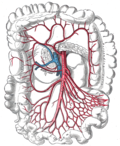 Mesenteric arteries
 -
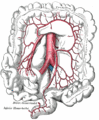 Inferior mesenteric artery


Medical Disclaimer: WikiMD is for informational purposes only and is not a substitute for professional medical advice. Content may be inaccurate or outdated and should not be used for diagnosis or treatment. Always consult your healthcare provider for medical decisions. Verify information with trusted sources such as CDC.gov and NIH.gov. By using this site, you agree that WikiMD is not liable for any outcomes related to its content. See full disclaimer.
Credits:Most images are courtesy of Wikimedia commons, and templates, categories Wikipedia, licensed under CC BY SA or similar.
Translate page: - East Asian
中文,
日本,
한국어,
South Asian
हिन्दी,
தமிழ்,
తెలుగు,
Urdu,
ಕನ್ನಡ,
Southeast Asian
Indonesian,
Vietnamese,
Thai,
မြန်မာဘာသာ,
বাংলা
European
español,
Deutsch,
français,
Greek,
português do Brasil,
polski,
română,
русский,
Nederlands,
norsk,
svenska,
suomi,
Italian
Middle Eastern & African
عربى,
Turkish,
Persian,
Hebrew,
Afrikaans,
isiZulu,
Kiswahili,
Other
Bulgarian,
Hungarian,
Czech,
Swedish,
മലയാളം,
मराठी,
ਪੰਜਾਬੀ,
ગુજરાતી,
Portuguese,
Ukrainian

