Memela
Memela is a traditional food item originating from the Mesoamerican region, specifically from the Nahuatl culture. It is a type of corn dough-based food, similar to a tortilla, but thicker and often topped with various ingredients.
History[edit]
The history of Memela dates back to the ancient Mesoamerican civilizations, particularly the Nahuatl people. The Nahuatl, like many other Mesoamerican cultures, had a diet heavily based on corn. The process of nixtamalization, a method for processing corn, was a significant culinary development during this period, leading to the creation of various corn-based foods, including Memela.
Preparation[edit]
Memela is made from masa, a type of dough made from corn that has undergone nixtamalization. The masa is shaped into a thick, round disk, similar to a tortilla but with raised edges. It is then cooked on a comal, a traditional flat griddle.
Once the Memela is cooked, it is typically topped with various ingredients. Common toppings include refried beans, cheese, salsa, and meat. However, the specific toppings can vary widely depending on the region and personal preference.
Cultural Significance[edit]
Memela is a staple food in many regions of Mexico, particularly in the states of Oaxaca and Puebla. It is often eaten for breakfast or as a snack, and is a common street food. Memela is also a significant part of various cultural and religious celebrations, including Day of the Dead and Cinco de Mayo.
See Also[edit]
 | This Mexican food article is a stub. You can help WikiMD by expanding the page. |

-
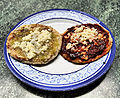 Memelas


Medical Disclaimer: WikiMD is for informational purposes only and is not a substitute for professional medical advice. Content may be inaccurate or outdated and should not be used for diagnosis or treatment. Always consult your healthcare provider for medical decisions. Verify information with trusted sources such as CDC.gov and NIH.gov. By using this site, you agree that WikiMD is not liable for any outcomes related to its content. See full disclaimer.
Credits:Most images are courtesy of Wikimedia commons, and templates, categories Wikipedia, licensed under CC BY SA or similar.
Translate page: - East Asian
中文,
日本,
한국어,
South Asian
हिन्दी,
தமிழ்,
తెలుగు,
Urdu,
ಕನ್ನಡ,
Southeast Asian
Indonesian,
Vietnamese,
Thai,
မြန်မာဘာသာ,
বাংলা
European
español,
Deutsch,
français,
Greek,
português do Brasil,
polski,
română,
русский,
Nederlands,
norsk,
svenska,
suomi,
Italian
Middle Eastern & African
عربى,
Turkish,
Persian,
Hebrew,
Afrikaans,
isiZulu,
Kiswahili,
Other
Bulgarian,
Hungarian,
Czech,
Swedish,
മലയാളം,
मराठी,
ਪੰਜਾਬੀ,
ગુજરાતી,
Portuguese,
Ukrainian

