Medicinal jar
Medicinal jar is a type of container used for storing medicine or other pharmaceutical products. These jars are typically made from materials such as glass, ceramic, or plastic, and are designed to protect their contents from contamination, light, and moisture.
History[edit]
The use of medicinal jars dates back to ancient times. In Ancient Egypt, for example, medicinal jars were used to store various types of herbal medicines and ointments. These jars were often decorated with symbols or images related to health and healing.
In the Middle Ages, medicinal jars were commonly used in apothecary shops. These jars were typically made of glass or ceramic and were often beautifully decorated. They were used to store a wide range of products, including herbs, spices, ointments, and potions.
Modern Use[edit]
Today, medicinal jars are used in a variety of settings, including pharmacies, hospitals, and research laboratories. They are used to store a wide range of products, including pills, capsules, liquid medicines, and powders.
Modern medicinal jars are typically made from plastic or glass. They are often transparent or semi-transparent, allowing the contents to be easily seen. They are also typically airtight, to protect the contents from contamination and moisture.
Types of Medicinal Jars[edit]
There are several different types of medicinal jars, including:
- Liquid medicine jars: These are used to store liquid medicines. They often have a measuring device, such as a dropper or a cup, attached to the lid.
- Powder jars: These are used to store powders. They are typically larger than pill jars and have a wide mouth for easy access.
See Also[edit]

-
 Tin glazed earthenware drug jar used for mustard, Sicilian
 -
 Pill tile, England, 1617-1700
 -
 Syria made medicinal jars circa 1300 excavated in Fenchurch Street London
 -
 Spain, Paterna, 14th century - Albarello with Two Rabbits
 -
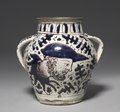 Giunta di Tugio - Two-Handled "Oak Leaf" Drug Jar with Male and Female Portraits
 -
 Syrup jar for Oil of Foxes, Italy, 1701-1800
 -
 Faentine 16th Century, Albarello with white-bearded, turbaned physician and trophies of arms, c. 1550-1575
 -
 Faentine 16th Century, Drug jar with the head of a warrior, c. 1540-1550


Medical Disclaimer: WikiMD is for informational purposes only and is not a substitute for professional medical advice. Content may be inaccurate or outdated and should not be used for diagnosis or treatment. Always consult your healthcare provider for medical decisions. Verify information with trusted sources such as CDC.gov and NIH.gov. By using this site, you agree that WikiMD is not liable for any outcomes related to its content. See full disclaimer.
Credits:Most images are courtesy of Wikimedia commons, and templates, categories Wikipedia, licensed under CC BY SA or similar.
Translate page: - East Asian
中文,
日本,
한국어,
South Asian
हिन्दी,
தமிழ்,
తెలుగు,
Urdu,
ಕನ್ನಡ,
Southeast Asian
Indonesian,
Vietnamese,
Thai,
မြန်မာဘာသာ,
বাংলা
European
español,
Deutsch,
français,
Greek,
português do Brasil,
polski,
română,
русский,
Nederlands,
norsk,
svenska,
suomi,
Italian
Middle Eastern & African
عربى,
Turkish,
Persian,
Hebrew,
Afrikaans,
isiZulu,
Kiswahili,
Other
Bulgarian,
Hungarian,
Czech,
Swedish,
മലയാളം,
मराठी,
ਪੰਜਾਬੀ,
ગુજરાતી,
Portuguese,
Ukrainian

