Macadamia tetraphylla
Macadamia tetraphylla is a species of tree in the family Proteaceae, native to southeastern Queensland and northeastern New South Wales in Australia. It is known by the common names rough-shelled macadamia or Queensland nut.
Description[edit]
Macadamia tetraphylla is an evergreen tree that grows up to 18 meters tall. The leaves, which are always in whorls of three or four, are 7.5–25 cm long and 2–4 cm wide with toothed margins. The flowers are arranged in spikes or racemes 5–10 cm long. The fruit is a hard, woody, globose follicle with a pointed apex, containing one or two seeds.
Taxonomy[edit]
The species was first formally described by the botanist Ferdinand von Mueller in 1857. The specific epithet (tetraphylla) is derived from the ancient Greek words tetra- meaning "four" and -phylla meaning "leaves".
Cultivation[edit]
Macadamia tetraphylla is commercially grown for its nuts. The nuts are a valuable food crop in Australia and are also exported to Japan, Europe, and North America. The tree is also grown as an ornamental for its glossy foliage and attractive flowers.
Ecology[edit]
The tree is a key species in the rainforest ecosystems of eastern Australia, providing habitat and food for a variety of wildlife. It is also a host plant for the larvae of the macadamia nut borer and the macadamia lace bug.
Conservation[edit]
Macadamia tetraphylla is listed as vulnerable by the IUCN. Threats to the species include habitat loss due to land clearing for agriculture and urban development, as well as predation of the nuts by introduced species such as rats and possums.
See also[edit]

Macadamia_tetraphylla[edit]
-
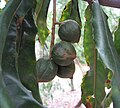 Macadamia tetraphylla
 -
 Macadamia tetraphylla branch and flower
 -
 Macadamia tetraphylla flower


Medical Disclaimer: WikiMD is for informational purposes only and is not a substitute for professional medical advice. Content may be inaccurate or outdated and should not be used for diagnosis or treatment. Always consult your healthcare provider for medical decisions. Verify information with trusted sources such as CDC.gov and NIH.gov. By using this site, you agree that WikiMD is not liable for any outcomes related to its content. See full disclaimer.
Credits:Most images are courtesy of Wikimedia commons, and templates, categories Wikipedia, licensed under CC BY SA or similar.
Translate this page: - East Asian
中文,
日本,
한국어,
South Asian
हिन्दी,
தமிழ்,
తెలుగు,
Urdu,
ಕನ್ನಡ,
Southeast Asian
Indonesian,
Vietnamese,
Thai,
မြန်မာဘာသာ,
বাংলা
European
español,
Deutsch,
français,
Greek,
português do Brasil,
polski,
română,
русский,
Nederlands,
norsk,
svenska,
suomi,
Italian
Middle Eastern & African
عربى,
Turkish,
Persian,
Hebrew,
Afrikaans,
isiZulu,
Kiswahili,
Other
Bulgarian,
Hungarian,
Czech,
Swedish,
മലയാളം,
मराठी,
ਪੰਜਾਬੀ,
ગુજરાતી,
Portuguese,
Ukrainian
