Lymph node
Small, bean-shaped organs of the lymphatic system
A lymph node is a small, bean-shaped structure that is part of the body's lymphatic system. Lymph nodes are distributed widely throughout the body and are linked by lymphatic vessels. They are major sites of B cell and T cell lymphocytes, and other white blood cells. Lymph nodes act as filters for foreign particles and cancer cells.
Structure[edit]
Lymph nodes are small, soft, round or oval structures that are usually not palpable. They are located along the lymphatic vessels and are most densely clustered in the neck, armpits, and groin. Each lymph node is surrounded by a fibrous capsule, which extends inside the node to form trabeculae. The internal structure of a lymph node is divided into the outer cortex and the inner medulla.
Cortex[edit]
The cortex is the outer part of the lymph node and contains follicles, which are collections of lymphocytes. The follicles can be primary or secondary, with secondary follicles having a germinal center where B cells proliferate and differentiate.
Medulla[edit]
The medulla is the inner part of the lymph node and contains medullary cords, which are extensions of the cortex. The medullary cords contain lymphocytes, plasma cells, and macrophages. The medullary sinuses are spaces that allow lymph to flow through the node.
Function[edit]
Lymph nodes play a crucial role in the body's immune response. They filter lymph, trapping bacteria, viruses, and other foreign substances, which are then destroyed by specialized white blood cells called lymphocytes. Lymph nodes also produce lymphocytes, which are essential for the immune response.
Immune Response[edit]
When an antigen is detected in the lymph, it is presented to lymphocytes in the lymph node. This triggers an immune response, leading to the activation and proliferation of lymphocytes. Activated B cells can differentiate into plasma cells that produce antibodies, while T cells can directly attack infected cells.
Clinical Significance[edit]
Lymph nodes can become swollen due to infections, inflammation, or cancer. Swollen lymph nodes, or lymphadenopathy, can be a sign of various conditions, ranging from minor infections to serious diseases like lymphoma or metastatic cancer.
Lymphadenopathy[edit]
Lymphadenopathy refers to the enlargement of lymph nodes. It can be localized, affecting nodes in a specific area, or generalized, affecting nodes throughout the body. Causes of lymphadenopathy include infections, autoimmune diseases, and malignancies.
Lymphoma[edit]
Lymphoma is a type of cancer that originates in the lymphatic system, particularly in the lymph nodes. It is classified into Hodgkin lymphoma and non-Hodgkin lymphoma, each with distinct characteristics and treatment approaches.
Related pages[edit]
| Organs of the lymphatic system | ||||
|---|---|---|---|---|
|
Lymph node[edit]
-
Lymphknoten (Schwein)
-
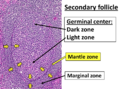 Dark, light, mantle and marginal zones of a secondary follicle
 -
Lymphatic immune system lymph node
-
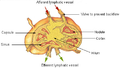 Illustration of lymph node structure
 -
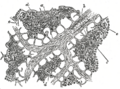 Gray's Anatomy illustration of lymph node
 -
Diagram of a lymph node
-
 Swollen Lymph Nodes
 -
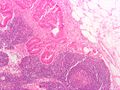 CRC metastasis to node


Medical Disclaimer: WikiMD is for informational purposes only and is not a substitute for professional medical advice. Content may be inaccurate or outdated and should not be used for diagnosis or treatment. Always consult your healthcare provider for medical decisions. Verify information with trusted sources such as CDC.gov and NIH.gov. By using this site, you agree that WikiMD is not liable for any outcomes related to its content. See full disclaimer.
Credits:Most images are courtesy of Wikimedia commons, and templates, categories Wikipedia, licensed under CC BY SA or similar.
Translate page: - East Asian
中文,
日本,
한국어,
South Asian
हिन्दी,
தமிழ்,
తెలుగు,
Urdu,
ಕನ್ನಡ,
Southeast Asian
Indonesian,
Vietnamese,
Thai,
မြန်မာဘာသာ,
বাংলা
European
español,
Deutsch,
français,
Greek,
português do Brasil,
polski,
română,
русский,
Nederlands,
norsk,
svenska,
suomi,
Italian
Middle Eastern & African
عربى,
Turkish,
Persian,
Hebrew,
Afrikaans,
isiZulu,
Kiswahili,
Other
Bulgarian,
Hungarian,
Czech,
Swedish,
മലയാളം,
मराठी,
ਪੰਜਾਬੀ,
ગુજરાતી,
Portuguese,
Ukrainian


.jpg)

