Logistic function
The logistic function, also known as the sigmoid function, is a mathematical function that maps an input value to a value between 0 and 1. It is commonly used in various fields, including biology, economics, and machine learning. The logistic function is defined by the formula:
{{{1}}} }}
where e
is the base of the natural logarithm and x
is the input value.
Properties[edit]
The logistic function has several important properties that make it useful in various applications.
Firstly, the logistic function is bounded between 0 and 1. As x
approaches negative infinity, the function approaches 0, and as x
approaches positive infinity, the function approaches 1. This property makes the logistic function suitable for modeling probabilities or representing values that are constrained within a specific range.
Secondly, the logistic function is symmetric around the point {{{1}}} . This means that the function's output is the same for x
and -x
. This symmetry property is often exploited in statistical modeling and data analysis.
Thirdly, the logistic function has a characteristic S-shaped curve. The curve starts off with a steep slope near the origin, gradually flattens out in the middle, and then approaches a horizontal asymptote as x
becomes large. This shape allows the logistic function to capture both rapid changes and saturation effects in various phenomena.
Applications[edit]
The logistic function finds applications in a wide range of fields. Here are a few notable examples:
Biology[edit]
In biology, the logistic function is commonly used to model population growth. It describes how a population grows exponentially at first, but eventually levels off due to limited resources or other factors. The logistic function helps researchers understand and predict the dynamics of populations in ecological systems.
Economics[edit]
In economics, the logistic function is used to model market saturation and adoption rates of new products or technologies. It helps economists analyze how markets reach equilibrium and how the demand for a product or service evolves over time.
Machine Learning[edit]
In machine learning, the logistic function is a fundamental component of logistic regression. Logistic regression is a popular classification algorithm that predicts the probability of an event occurring based on input features. The logistic function is used to map the linear combination of input features to a probability value between 0 and 1.
See Also[edit]
References[edit]
-
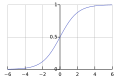 Logistic curve
 -
 Verhulst's logistic curve, 1845
 -
 Derivatives of the logistic function
 -
 Pierre François Verhulst
 -
 Combined logistic growth functions
 -
 COVID-19 outbreak logistic curve
 -
 Sugarcane S-curve
 -
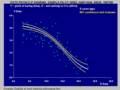 Barley S-curve


Medical Disclaimer: WikiMD is for informational purposes only and is not a substitute for professional medical advice. Content may be inaccurate or outdated and should not be used for diagnosis or treatment. Always consult your healthcare provider for medical decisions. Verify information with trusted sources such as CDC.gov and NIH.gov. By using this site, you agree that WikiMD is not liable for any outcomes related to its content. See full disclaimer.
Credits:Most images are courtesy of Wikimedia commons, and templates, categories Wikipedia, licensed under CC BY SA or similar.
Translate page: - East Asian
中文,
日本,
한국어,
South Asian
हिन्दी,
தமிழ்,
తెలుగు,
Urdu,
ಕನ್ನಡ,
Southeast Asian
Indonesian,
Vietnamese,
Thai,
မြန်မာဘာသာ,
বাংলা
European
español,
Deutsch,
français,
Greek,
português do Brasil,
polski,
română,
русский,
Nederlands,
norsk,
svenska,
suomi,
Italian
Middle Eastern & African
عربى,
Turkish,
Persian,
Hebrew,
Afrikaans,
isiZulu,
Kiswahili,
Other
Bulgarian,
Hungarian,
Czech,
Swedish,
മലയാളം,
मराठी,
ਪੰਜਾਬੀ,
ગુજરાતી,
Portuguese,
Ukrainian

