Loco moco
Loco moco is a traditional dish originating from Hawaii. It is a part of the local cuisine known as Hawaiian cuisine. The dish is a part of the plate lunch tradition in Hawaii and is popular in both fast food and fine dining settings.
History[edit]
The dish was reportedly created in the late 1940s at the Lincoln Grill restaurants in Hilo, Hawaii, by a group of teenagers who wanted something different from a sandwich, cheaper than a steak, and that could be eaten with a fork, not requiring a knife. The term "loco moco" is derived from the Hawaiian word "loco", which means "crazy", and "moco", which is a play on the English word "moco", meaning "mucus". This name was chosen to describe the dish's gravy-like appearance.
Ingredients and Preparation[edit]
Loco moco consists of white rice, topped with a hamburger patty, a fried egg, and brown gravy. Variations may include chili, bacon, ham, Spam, kalua pork, Portuguese sausage, teriyaki beef, teriyaki chicken, mahi-mahi, shrimp, oysters, and other meats. Loco moco is also the name of a Hawaiian-based restaurant chain that serves Hawaiian rice bowl dishes.
Cultural Significance[edit]
Loco moco has become a staple of Hawaiian cuisine and is often served at lunch and dinner. It is a comfort food and is popularly served at local fast food chains, diners, and at high-end restaurants, where it may be dressed up with gourmet ingredients. The dish is also a common offering at Hawaiian plate lunch places.
Loco Moco in Popular Culture[edit]
Loco moco has been featured in various travel and food-related television shows as a symbol of Hawaiian culinary tradition. It is also a popular dish at the annual Hawaii Food & Wine Festival.
See Also[edit]
 | This Hawaiʻi-related article is a stub. You can help WikiMD by expanding the page. |

Loco moco[edit]
-
 Loco Moco at Ethel's Grill, Honolulu, Hawaii
 -
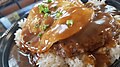 Loco Moco with egg and gravy
 -
 Fish Loco Moco
 -
 Classic Loco Moco
 -
 Loco Moco with rice and egg
 -
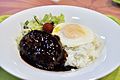 Loco Moco dish
 -
 Homestyle Hawaiian Loco Moco

.jpg)


.jpg)


Medical Disclaimer: WikiMD is for informational purposes only and is not a substitute for professional medical advice. Content may be inaccurate or outdated and should not be used for diagnosis or treatment. Always consult your healthcare provider for medical decisions. Verify information with trusted sources such as CDC.gov and NIH.gov. By using this site, you agree that WikiMD is not liable for any outcomes related to its content. See full disclaimer.
Credits:Most images are courtesy of Wikimedia commons, and templates, categories Wikipedia, licensed under CC BY SA or similar.
Translate page: - East Asian
中文,
日本,
한국어,
South Asian
हिन्दी,
தமிழ்,
తెలుగు,
Urdu,
ಕನ್ನಡ,
Southeast Asian
Indonesian,
Vietnamese,
Thai,
မြန်မာဘာသာ,
বাংলা
European
español,
Deutsch,
français,
Greek,
português do Brasil,
polski,
română,
русский,
Nederlands,
norsk,
svenska,
suomi,
Italian
Middle Eastern & African
عربى,
Turkish,
Persian,
Hebrew,
Afrikaans,
isiZulu,
Kiswahili,
Other
Bulgarian,
Hungarian,
Czech,
Swedish,
മലയാളം,
मराठी,
ਪੰਜਾਬੀ,
ગુજરાતી,
Portuguese,
Ukrainian

