List of edible invasive species
Invasive species are plants, animals, or other organisms that are not native to a specific location and have a tendency to spread, causing damage to the environment, human economy, or health. However, some invasive species are edible and can be utilized as food sources, potentially aiding in their control. This article provides a list of edible invasive species, highlighting their culinary uses and geographical spread.
Plants[edit]
Japanese Knotweed (Fallopia japonica)[edit]
Japanese Knotweed is a large, herbaceous perennial plant native to East Asia in Japan, China, and Korea. It has been introduced to Europe and North America, where it has become a problematic invasive species. Despite its invasive nature, the young shoots of Japanese Knotweed are edible and can be prepared similarly to rhubarb.
Kudzu (Pueraria montana var. lobata)[edit]
Kudzu is a climbing, coiling, and trailing vine native to Asia. It has been introduced to the United States and is known for its rapid growth, covering trees and shrubs. Kudzu leaves, roots, flowers, and young shoots are edible. The roots can be used to make starch, and the leaves are often used in salads or cooked as greens.
Animals[edit]
Asian Carp[edit]
Asian carp is a term used to refer to several species of fish native to China and Russia, including Bighead, Silver, Grass, and Black carp. These species have become invasive in the United States, threatening the Great Lakes ecosystem. Asian carp are edible and are considered a delicacy in many parts of the world. They can be prepared in various ways, including frying, baking, and grilling.
Lionfish (Pterois)[edit]
Lionfish are native to the Indo-Pacific but have become invasive along the southeast coast of the U.S., the Caribbean, and parts of the Gulf of Mexico. Known for their venomous spines, lionfish are nonetheless edible once the spines are carefully removed. They are often prepared grilled, baked, or in ceviche.
Challenges and Opportunities[edit]
While utilizing edible invasive species as food can contribute to their control, it is important to manage such efforts sustainably to avoid unintended ecological impacts. Proper identification and knowledge of safe preparation methods are essential to prevent potential health risks.
See Also[edit]
This list is incomplete; you can help WikiMD by expanding it.
List of edible invasive species[edit]
-
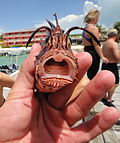 Lionfish, Belize
.jpg)

Medical Disclaimer: WikiMD is for informational purposes only and is not a substitute for professional medical advice. Content may be inaccurate or outdated and should not be used for diagnosis or treatment. Always consult your healthcare provider for medical decisions. Verify information with trusted sources such as CDC.gov and NIH.gov. By using this site, you agree that WikiMD is not liable for any outcomes related to its content. See full disclaimer.
Credits:Most images are courtesy of Wikimedia commons, and templates, categories Wikipedia, licensed under CC BY SA or similar.
Translate page: - East Asian
中文,
日本,
한국어,
South Asian
हिन्दी,
தமிழ்,
తెలుగు,
Urdu,
ಕನ್ನಡ,
Southeast Asian
Indonesian,
Vietnamese,
Thai,
မြန်မာဘာသာ,
বাংলা
European
español,
Deutsch,
français,
Greek,
português do Brasil,
polski,
română,
русский,
Nederlands,
norsk,
svenska,
suomi,
Italian
Middle Eastern & African
عربى,
Turkish,
Persian,
Hebrew,
Afrikaans,
isiZulu,
Kiswahili,
Other
Bulgarian,
Hungarian,
Czech,
Swedish,
മലയാളം,
मराठी,
ਪੰਜਾਬੀ,
ગુજરાતી,
Portuguese,
Ukrainian

