Lingual gyrus
The Lingual gyrus is part of the brain located in the occipital lobe, specifically on the underside of the brain. It is named for its proximity to the tongue, as "lingual" is derived from the Latin word "lingua," which means tongue. The Lingual gyrus is part of the visual cortex, which is responsible for processing visual information.
Etymology[edit]
The term "Lingual gyrus" comes from the Latin word "lingua," which means tongue. This is due to the gyrus's location near the tongue-shaped occipital lobe of the brain.
Anatomy[edit]
The Lingual gyrus is located between the calcarine sulcus and the collateral sulcus; it extends from the occipital pole to the occipitotemporal sulcus. It is part of the visual cortex, which is responsible for processing visual information.
Function[edit]
The Lingual gyrus plays a significant role in visual processing. It is involved in the processing of visual signals, the formation of memories related to visual input, and the recognition and identification of objects. It is also thought to play a role in dreaming and daydreaming.
Clinical significance[edit]
Damage to the Lingual gyrus can result in a variety of visual disorders, including visual agnosia, prosopagnosia, and hallucinations. It has also been associated with conditions such as schizophrenia and Alzheimer's disease.
Related terms[edit]
- Gyrus
- Occipital lobe
- Visual cortex
- Calcarine sulcus
- Collateral sulcus
- Occipital pole
- Occipitotemporal sulcus
- Visual agnosia
- Prosopagnosia
- Hallucinations
- Schizophrenia
- Alzheimer's disease

This WikiMD article can only be edited by registered and verified editors. You can log in or register.
-
 Animation of the lingual gyrus
 -
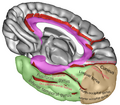 Medial view of the occipital lobe
 -
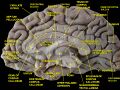 Lingual gyrus in a brain slide
 -
 Inner view of the lingual gyrus from DK Atlas
 -
 Sagittal sections of the lingual gyrus
 -
 Coronal sections of the lingual gyrus
 -
 Transversal sections of the lingual gyrus


Medical Disclaimer: WikiMD is for informational purposes only and is not a substitute for professional medical advice. Content may be inaccurate or outdated and should not be used for diagnosis or treatment. Always consult your healthcare provider for medical decisions. Verify information with trusted sources such as CDC.gov and NIH.gov. By using this site, you agree that WikiMD is not liable for any outcomes related to its content. See full disclaimer.
Credits:Most images are courtesy of Wikimedia commons, and templates, categories Wikipedia, licensed under CC BY SA or similar.
Translate page: - East Asian
中文,
日本,
한국어,
South Asian
हिन्दी,
தமிழ்,
తెలుగు,
Urdu,
ಕನ್ನಡ,
Southeast Asian
Indonesian,
Vietnamese,
Thai,
မြန်မာဘာသာ,
বাংলা
European
español,
Deutsch,
français,
Greek,
português do Brasil,
polski,
română,
русский,
Nederlands,
norsk,
svenska,
suomi,
Italian
Middle Eastern & African
عربى,
Turkish,
Persian,
Hebrew,
Afrikaans,
isiZulu,
Kiswahili,
Other
Bulgarian,
Hungarian,
Czech,
Swedish,
മലയാളം,
मराठी,
ਪੰਜਾਬੀ,
ગુજરાતી,
Portuguese,
Ukrainian

