Arcuate popliteal ligament
[[File: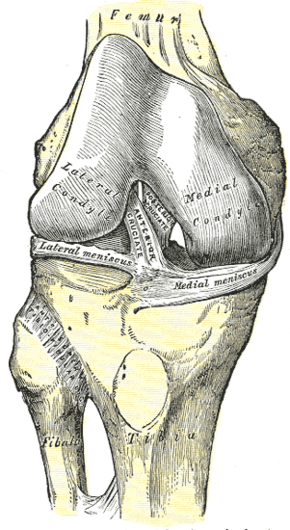 |frameless|alt=]]

| Details | |
|---|---|
| Synonyms | |
| Pronunciation | |
| Carnegie stage | |
| Days | |
| Precursor | |
| Gives rise to | |
| Part of | |
The Arcuate popliteal ligament (Ligamentum popliteum arcuatum) is a thick and broad fibrous band located in the knee joint. It is one of the important ligaments that provide stability to the knee joint.
Anatomy[edit]
The arcuate popliteal ligament originates from the apex of the head of the fibula and extends upwards and medially, crossing the posterior aspect of the knee joint. It then attaches to the intercondylar area of the tibia and the posterior part of the joint capsule.
Function[edit]
The arcuate popliteal ligament plays a crucial role in maintaining the stability of the knee joint. It prevents excessive movement and helps in the smooth functioning of the knee joint.
Clinical significance[edit]
Injury to the arcuate popliteal ligament can lead to instability of the knee joint, causing pain and difficulty in movement. Treatment usually involves rest, physiotherapy, and in severe cases, surgery may be required.
See also[edit]
References[edit]

Medical Disclaimer: WikiMD is for informational purposes only and is not a substitute for professional medical advice. Content may be inaccurate or outdated and should not be used for diagnosis or treatment. Always consult your healthcare provider for medical decisions. Verify information with trusted sources such as CDC.gov and NIH.gov. By using this site, you agree that WikiMD is not liable for any outcomes related to its content. See full disclaimer.
Credits:Most images are courtesy of Wikimedia commons, and templates, categories Wikipedia, licensed under CC BY SA or similar.
Translate page: - East Asian
中文,
日本,
한국어,
South Asian
हिन्दी,
தமிழ்,
తెలుగు,
Urdu,
ಕನ್ನಡ,
Southeast Asian
Indonesian,
Vietnamese,
Thai,
မြန်မာဘာသာ,
বাংলা
European
español,
Deutsch,
français,
Greek,
português do Brasil,
polski,
română,
русский,
Nederlands,
norsk,
svenska,
suomi,
Italian
Middle Eastern & African
عربى,
Turkish,
Persian,
Hebrew,
Afrikaans,
isiZulu,
Kiswahili,
Other
Bulgarian,
Hungarian,
Czech,
Swedish,
മലയാളം,
मराठी,
ਪੰਜਾਬੀ,
ગુજરાતી,
Portuguese,
Ukrainian

