Pterygoid processes of the sphenoid


Paired processes of the sphenoid bone in the skull
[[File: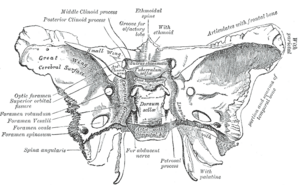 |frameless|alt=]]
| Details | |
|---|---|
| Synonyms | |
| Pronunciation | |
| Carnegie stage | |
| Days | |
| Precursor | Pharyngeal arch 1 |
| Gives rise to | |
| Part of | |
The pterygoid processes of the sphenoid are paired projections that extend from the inferior aspect of the sphenoid bone in the human skull. These processes are important anatomical landmarks and serve as points of attachment for various muscles and ligaments associated with the jaw and pharynx.
Anatomy[edit]
The pterygoid processes consist of two plates: the medial pterygoid plate and the lateral pterygoid plate. These plates are separated by the pterygoid fossa, which houses the medial pterygoid muscle.
Medial Pterygoid Plate[edit]
The medial pterygoid plate is a thin, elongated structure that extends downward from the sphenoid bone. It forms part of the lateral wall of the nasal cavity and provides attachment for the tensor veli palatini muscle and the superior pharyngeal constrictor muscle.
Lateral Pterygoid Plate[edit]
The lateral pterygoid plate is broader and more robust than the medial plate. It serves as the origin for the lateral pterygoid muscle and the medial pterygoid muscle, both of which are involved in the movements of the mandible.
Function[edit]
The pterygoid processes play a crucial role in the function of the temporomandibular joint (TMJ) by providing attachment points for muscles that facilitate the movement of the jaw. These processes also contribute to the structural integrity of the skull and the nasal cavity.
Clinical Significance[edit]
Injuries or abnormalities involving the pterygoid processes can affect the function of the jaw and the pharynx. Conditions such as pterygoid hamulus syndrome and temporomandibular joint disorder (TMD) may involve the pterygoid processes.
Additional Images[edit]
See Also[edit]
References[edit]
 | This medical article is a stub. You can help WikiMD by expanding the page. |
Advertise on WikiMD — 81,000+ full articles, ~900,000 total pages, ~250 million page views. Global reach, limited time promotional rates from $1/page/day. Learn more · View stats


Translate page: - East Asian
中文,
日本,
한국어,
South Asian
हिन्दी,
தமிழ்,
తెలుగు,
Urdu,
ಕನ್ನಡ,
Southeast Asian
Indonesian,
Vietnamese,
Thai,
မြန်မာဘာသာ,
বাংলা
European
español,
Deutsch,
français,
Greek,
português do Brasil,
polski,
română,
русский,
Nederlands,
norsk,
svenska,
suomi,
Italian
Middle Eastern & African
عربى,
Turkish,
Persian,
Hebrew,
Afrikaans,
isiZulu,
Kiswahili,
Other
Bulgarian,
Hungarian,
Czech,
Swedish,
മലയാളം,
मराठी,
ਪੰਜਾਬੀ,
ગુજરાતી,
Portuguese,
Ukrainian
About WikiMD • Contact • Disclaimer • Privacy • Copyright • Site statistics
Some content and images may originate from Wikimedia Commons or Wikipedia and remain subject to their stated licenses. Unless otherwise noted, eligible WikiMD content is available under CC BY-SA 4.0.
WikiMD Wellnesspedia — Free health & wellness information for patients, students, and health professionals.

