Laser
A Laser (an acronym for Light Amplification by Stimulated Emission of Radiation) is a device that emits light through a process of optical amplification based on the stimulated emission of electromagnetic radiation. The term "laser" originated as an acronym for "light amplification by stimulated emission of radiation".
History[edit]
The first working laser was built in 1960 by Theodore H. Maiman at Hughes Research Laboratories, based on theoretical work by Charles Hard Townes and Arthur Leonard Schawlow.
Principle of operation[edit]
Lasers are distinguished from other light sources by their coherence. Spatial coherence is typically expressed through the output being a narrow beam, which is diffraction-limited. Lasers can also have high temporal coherence, which allows them to emit light with a very narrow spectrum.
Types of lasers[edit]
There are many types of lasers including gas lasers, chemical lasers, dye lasers, metal-vapor lasers, solid-state lasers, semiconductor lasers, dye lasers, and excimer lasers.
Applications[edit]
Lasers have many applications in areas such as medicine, the military, research, industry, and consumer electronics.
Safety[edit]
Due to the potential for physical harm, several standards exist for those who work with lasers.
See also[edit]
References[edit]

This WikiMD article can only be edited by registered and verified editors. You can log in or register.
Laser[edit]
-
Guiding the Milky Way
-
Green Laser
-
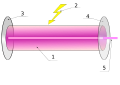 Laser
Laser -
Laser, quantum principle
-
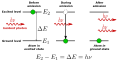 Stimulated Emission
 -
Laser DSC09088
-
Helium neon laser spectrum
-
Lasers
-
Moon clementine lidar
-
Laserlink hss46
-
MESSENGER - MLA
-
Aleksandr Prokhorov


Medical Disclaimer: WikiMD is for informational purposes only and is not a substitute for professional medical advice. Content may be inaccurate or outdated and should not be used for diagnosis or treatment. Always consult your healthcare provider for medical decisions. Verify information with trusted sources such as CDC.gov and NIH.gov. By using this site, you agree that WikiMD is not liable for any outcomes related to its content. See full disclaimer.
Credits:Most images are courtesy of Wikimedia commons, and templates, categories Wikipedia, licensed under CC BY SA or similar.
Translate page: - East Asian
中文,
日本,
한국어,
South Asian
हिन्दी,
தமிழ்,
తెలుగు,
Urdu,
ಕನ್ನಡ,
Southeast Asian
Indonesian,
Vietnamese,
Thai,
မြန်မာဘာသာ,
বাংলা
European
español,
Deutsch,
français,
Greek,
português do Brasil,
polski,
română,
русский,
Nederlands,
norsk,
svenska,
suomi,
Italian
Middle Eastern & African
عربى,
Turkish,
Persian,
Hebrew,
Afrikaans,
isiZulu,
Kiswahili,
Other
Bulgarian,
Hungarian,
Czech,
Swedish,
മലയാളം,
मराठी,
ਪੰਜਾਬੀ,
ગુજરાતી,
Portuguese,
Ukrainian


.jpg)


