Anterior cruciate ligament injury

Editor-In-Chief: Prab R Tumpati, MD
Obesity, Sleep & Internal medicine
Founder, WikiMD Wellnesspedia &
W8MD's weight loss doctor NYC
Philadelphia GLP-1 weight loss and GLP-1 clinic NYC
| Anterior cruciate ligament injury | |
|---|---|

| |
| Synonyms | ACL injury, ACL tear |
| Pronounce | N/A |
| Specialty | Orthopedic surgery |
| Symptoms | Knee pain, knee instability, swelling |
| Complications | N/A |
| Onset | Sudden |
| Duration | Varies |
| Types | N/A |
| Causes | Trauma, sports injury |
| Risks | Athletic activity, contact sports, previous injury |
| Diagnosis | Physical examination, MRI |
| Differential diagnosis | Meniscus tear, collateral ligament injury |
| Prevention | Strength training, neuromuscular training |
| Treatment | Rest, physical therapy, surgery |
| Medication | N/A |
| Prognosis | Generally good with treatment |
| Frequency | Common in athletes |
| Deaths | N/A |
The Anterior Cruciate Ligament (ACL) is one of the key ligaments that help stabilize the knee joint. ACL injuries are among the most common knee injuries, especially in athletes who participate in high demand sports like soccer, football, and basketball. ACL injuries can range from mild (such as small tears/sprains) to severe (complete tears). The severity of the injury dictates the treatment and recovery process.
Causes[edit]
ACL injuries are most commonly caused by:
- Sudden stops or changes in direction
- Jumping and landing incorrectly
- Direct collision, such as during a football tackle
Symptoms[edit]
Symptoms of an ACL injury include:
- A loud "pop" or a "popping" sensation in the knee
- Severe pain and inability to continue activity
- Rapid swelling
- Loss of range of motion
- A feeling of instability or "giving way" with weight bearing
Diagnosis[edit]
Diagnosis of an ACL injury involves a physical examination and often imaging tests such as:
- Magnetic Resonance Imaging (MRI): To visualize the extent of the injury.
- X-ray: To rule out any bone fractures.
Treatment[edit]
Treatment options vary depending on the severity of the injury and the patient's needs. They include:
- Non-surgical treatment: Rehabilitation exercises and physical therapy to strengthen the muscles around the knee.
- Surgical treatment: ACL reconstruction surgery to replace the torn ligament with a piece of tendon from another part of the body or a donor.
Recovery[edit]
Recovery from an ACL injury can take several months. A combination of physical therapy, rehabilitation exercises, and, if necessary, surgery, can help an individual return to normal activities.
Prevention[edit]
Preventive measures include:
- Strengthening leg muscles
- Proper training and exercise techniques
- Using proper sports equipment
Anterior_cruciate_ligament_injury images[edit]
-
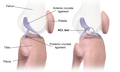 Image of an ACL tear
 -
 Labelled diagram showing the Q angle of the femur
 -
 Anatomical illustration of the knee joint
 -
 Detailed anatomy of the knee joint
 -
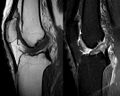 MRI image showing ACL injury


See Also[edit]
 | This medical article is a stub. You can help WikiMD by expanding the page. |

Medical Disclaimer: WikiMD is for informational purposes only and is not a substitute for professional medical advice. Content may be inaccurate or outdated and should not be used for diagnosis or treatment. Always consult your healthcare provider for medical decisions. Verify information with trusted sources such as CDC.gov and NIH.gov. By using this site, you agree that WikiMD is not liable for any outcomes related to its content. See full disclaimer.
Credits:Most images are courtesy of Wikimedia commons, and templates, categories Wikipedia, licensed under CC BY SA or similar.
Translate page: - East Asian
中文,
日本,
한국어,
South Asian
हिन्दी,
தமிழ்,
తెలుగు,
Urdu,
ಕನ್ನಡ,
Southeast Asian
Indonesian,
Vietnamese,
Thai,
မြန်မာဘာသာ,
বাংলা
European
español,
Deutsch,
français,
Greek,
português do Brasil,
polski,
română,
русский,
Nederlands,
norsk,
svenska,
suomi,
Italian
Middle Eastern & African
عربى,
Turkish,
Persian,
Hebrew,
Afrikaans,
isiZulu,
Kiswahili,
Other
Bulgarian,
Hungarian,
Czech,
Swedish,
മലയാളം,
मराठी,
ਪੰਜਾਬੀ,
ગુજરાતી,
Portuguese,
Ukrainian

