Histidine
Histidine is an amino acid that is used in the biosynthesis of proteins. It contains an amino group, a carboxyl group, and a side chain imidazole, making it a basic and polar amino acid. It is essential in humans, meaning the body cannot synthesize it and it must be ingested. Histidine was first isolated by German physician Albrecht Kossel in 1896.
Structure[edit]
Histidine is a alpha-amino acid that includes an imidazole functional group. It is one of the 23 proteinogenic amino acids. Its codons are CAU and CAC.
Biosynthesis[edit]
In bacteria and plants, histidine is synthesized from the sugar derivative phosphoribosyl pyrophosphate (PRPP). The process involves nine enzyme-catalyzed reactions and is regulated by the concentration of histidine itself.
Function[edit]
Histidine plays a critical role in the catalytic site of enzymes. The imidazole side chain has the ability to switch between protonated and unprotonated states, which allows histidine to participate in acid-base catalysis. In addition, histidine is involved in the regulation of the pH levels of bodily fluids.
Histidine is also needed for growth and the repair of tissues, as well as the maintenance of the myelin sheaths that protect nerve cells. It is further used to manufacture both red and white blood cells.
Dietary Sources[edit]
Histidine is found in a wide variety of foods, including meat, poultry, fish, dairy, and certain types of grain. It is also available as a dietary supplement.
Deficiency[edit]
Histidine deficiency can lead to symptoms such as eczema, inflammation of the skin, and even neurological issues. It is rare, but can occur in people with a genetic disorder that affects histidine absorption.
See Also[edit]
This amino acid related article is a stub. You can help WikiMD by expanding it.
-
 Histidine
 -
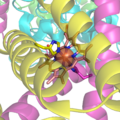 Succinate Dehydrogenase Haem Group
 -
 Laccase Structure
 -
 Histidine


Medical Disclaimer: WikiMD is for informational purposes only and is not a substitute for professional medical advice. Content may be inaccurate or outdated and should not be used for diagnosis or treatment. Always consult your healthcare provider for medical decisions. Verify information with trusted sources such as CDC.gov and NIH.gov. By using this site, you agree that WikiMD is not liable for any outcomes related to its content. See full disclaimer.
Credits:Most images are courtesy of Wikimedia commons, and templates, categories Wikipedia, licensed under CC BY SA or similar.
Translate page: - East Asian
中文,
日本,
한국어,
South Asian
हिन्दी,
தமிழ்,
తెలుగు,
Urdu,
ಕನ್ನಡ,
Southeast Asian
Indonesian,
Vietnamese,
Thai,
မြန်မာဘာသာ,
বাংলা
European
español,
Deutsch,
français,
Greek,
português do Brasil,
polski,
română,
русский,
Nederlands,
norsk,
svenska,
suomi,
Italian
Middle Eastern & African
عربى,
Turkish,
Persian,
Hebrew,
Afrikaans,
isiZulu,
Kiswahili,
Other
Bulgarian,
Hungarian,
Czech,
Swedish,
മലയാളം,
मराठी,
ਪੰਜਾਬੀ,
ગુજરાતી,
Portuguese,
Ukrainian

