Allylglycine
Allylglycine is a derivative of the amino acid glycine that has an allyl group replacing one of the hydrogen atoms. It is a convulsant drug that causes seizures by inhibiting the enzyme glutamic acid decarboxylase, thus reducing the production of the inhibitory neurotransmitter gamma-aminobutyric acid (GABA).
Chemistry[edit]
Allylglycine is a derivative of the amino acid glycine, where one of the hydrogen atoms is replaced by an allyl group. The allyl group consists of a carbon chain with a double bond, which gives the molecule its unique properties.
Pharmacology[edit]
Allylglycine acts as a convulsant drug, causing seizures by inhibiting the enzyme glutamic acid decarboxylase. This enzyme is responsible for the production of gamma-aminobutyric acid (GABA), an inhibitory neurotransmitter. By reducing the production of GABA, allylglycine disrupts the balance of excitatory and inhibitory signals in the brain, leading to increased neuronal activity and seizures.
Uses[edit]
While allylglycine itself is not used in medicine due to its convulsant effects, it is used in research to study the role of GABA in the brain and the mechanisms of seizures. It is also used to induce seizures in laboratory animals for the study of epilepsy and the development of new anticonvulsant drugs.
See also[edit]

This WikiMD article can only be edited by registered and verified editors. You can log in or register.
Allylglycine[edit]
-
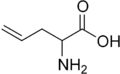 Allylglycine

Advertise on WikiMD — 81,000+ full articles, ~900,000 total pages, ~250 million page views. Global reach, limited time promotional rates from $1/page/day. Learn more · View stats


Translate page: - East Asian
中文,
日本,
한국어,
South Asian
हिन्दी,
தமிழ்,
తెలుగు,
Urdu,
ಕನ್ನಡ,
Southeast Asian
Indonesian,
Vietnamese,
Thai,
မြန်မာဘာသာ,
বাংলা
European
español,
Deutsch,
français,
Greek,
português do Brasil,
polski,
română,
русский,
Nederlands,
norsk,
svenska,
suomi,
Italian
Middle Eastern & African
عربى,
Turkish,
Persian,
Hebrew,
Afrikaans,
isiZulu,
Kiswahili,
Other
Bulgarian,
Hungarian,
Czech,
Swedish,
മലയാളം,
मराठी,
ਪੰਜਾਬੀ,
ગુજરાતી,
Portuguese,
Ukrainian
About WikiMD • Contact • Disclaimer • Privacy • Copyright • Site statistics
Some content and images may originate from Wikimedia Commons or Wikipedia and remain subject to their stated licenses. Unless otherwise noted, eligible WikiMD content is available under CC BY-SA 4.0.
WikiMD Wellnesspedia — Free health & wellness information for patients, students, and health professionals.

