Kunitz domain
The Kunitz domain is a protein domain that was first identified in the bovine pancreatic trypsin inhibitor (BPTI), a protein that belongs to the Kunitz-type protease inhibitor family. This domain is approximately 60 amino acids in length and is characterized by a specific fold that is stabilized by three disulfide bonds.
Structure[edit]
The Kunitz domain has a compact protein structure that is stabilized by three disulfide bonds. These bonds are formed between six cysteine residues that are conserved in the Kunitz domain sequence. The domain's structure also includes two beta sheets and one alpha helix, arranged in a specific orientation that is characteristic of the Kunitz domain.
Function[edit]
The primary function of the Kunitz domain is to inhibit serine proteases, a type of enzyme that breaks down proteins. The domain achieves this by binding to the enzyme's active site, preventing it from interacting with its substrate. However, not all proteins containing a Kunitz domain are protease inhibitors. Some, such as the amyloid precursor protein, use the Kunitz domain for other functions, including cell adhesion and neurite outgrowth.
Distribution[edit]
Kunitz domains are found in a wide range of organisms, from bacteria to mammals. They are particularly common in venomous creatures, such as snakes and sea anemones, where they are used to inhibit the prey's proteases and immobilize it.
Clinical significance[edit]
Due to their role in protease inhibition, Kunitz domains are of interest in the development of drugs for conditions that involve excessive protease activity, such as inflammation, cancer, and coagulation disorders.
See also[edit]
 | This protein-related article is a stub. You can help WikiMD by expanding the page. |
-
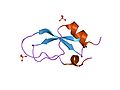 PDB 1kth EBI


Medical Disclaimer: WikiMD is for informational purposes only and is not a substitute for professional medical advice. Content may be inaccurate or outdated and should not be used for diagnosis or treatment. Always consult your healthcare provider for medical decisions. Verify information with trusted sources such as CDC.gov and NIH.gov. By using this site, you agree that WikiMD is not liable for any outcomes related to its content. See full disclaimer.
Credits:Most images are courtesy of Wikimedia commons, and templates, categories Wikipedia, licensed under CC BY SA or similar.
Translate page: - East Asian
中文,
日本,
한국어,
South Asian
हिन्दी,
தமிழ்,
తెలుగు,
Urdu,
ಕನ್ನಡ,
Southeast Asian
Indonesian,
Vietnamese,
Thai,
မြန်မာဘာသာ,
বাংলা
European
español,
Deutsch,
français,
Greek,
português do Brasil,
polski,
română,
русский,
Nederlands,
norsk,
svenska,
suomi,
Italian
Middle Eastern & African
عربى,
Turkish,
Persian,
Hebrew,
Afrikaans,
isiZulu,
Kiswahili,
Other
Bulgarian,
Hungarian,
Czech,
Swedish,
മലയാളം,
मराठी,
ਪੰਜਾਬੀ,
ગુજરાતી,
Portuguese,
Ukrainian

