Krupuk kulit
Krupuk Kulit: A Delicious Indonesian Snack[edit]
| Alternative names | |
| Type | |
| Course | Snack |
| Place of origin | Indonesia |
| Region or state | Southeast Asia |
| Associated national cuisine | |
| Created by | |
| Invented | |
| Cooking time | minutes to minutes |
| Serving temperature | Room temperature |
| Main ingredients | Animal skin, spices |
| Ingredients generally used | |
| Variations | |
| Food energy | kcal |
| Nutritional value | Protein: g, Fat: g, Carbohydrate: g |
| Glycemic index | |
| Similar dishes | |
| Other information | |
| Website | [ Official website] |
Krupuk Kulit is a popular Indonesian snack made from animal skin, typically from cows or pigs. It is a crispy and savory snack that is enjoyed by people of all ages in Indonesia. In this article, we will explore the history, ingredients, preparation, and cultural significance of Krupuk Kulit.
History[edit]
Krupuk Kulit has a long history in Indonesian cuisine. It is believed to have originated in Java, Indonesia, where it was traditionally made by drying and frying animal skin. Over time, different variations of Krupuk Kulit have emerged, each with its own unique flavors and textures.
Ingredients[edit]
The main ingredient of Krupuk Kulit is animal skin, which is usually sourced from cows or pigs. The skin is cleaned, boiled, and then dried under the sun. Once dried, it is deep-fried until it becomes crispy and golden brown. Various spices and seasonings, such as garlic, shallots, and chili powder, are added to enhance the flavor of the snack.
Preparation[edit]
To make Krupuk Kulit, the animal skin is first cleaned thoroughly to remove any impurities. It is then boiled until it becomes tender. After boiling, the skin is left to dry under the sun for several hours until it becomes hard and brittle. Once dried, it is cut into small pieces or strips and deep-fried in hot oil until it puffs up and turns crispy. The fried Krupuk Kulit is then drained to remove excess oil and is ready to be served.
Cultural Significance[edit]
Krupuk Kulit holds a special place in Indonesian culture and is often served during festive occasions, such as weddings, birthdays, and religious ceremonies. It is also commonly enjoyed as a snack with tea or coffee. The crispy texture and rich flavor of Krupuk Kulit make it a favorite among Indonesians and a must-try for visitors to the country.
See Also[edit]
References[edit]
-
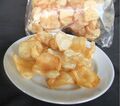 Kerupuk kulit

Advertise on WikiMD — 81,000+ full articles, ~900,000 total pages, ~250 million page views. Global reach, limited time promotional rates from $1/page/day. Learn more · View stats


Translate page: - East Asian
中文,
日本,
한국어,
South Asian
हिन्दी,
தமிழ்,
తెలుగు,
Urdu,
ಕನ್ನಡ,
Southeast Asian
Indonesian,
Vietnamese,
Thai,
မြန်မာဘာသာ,
বাংলা
European
español,
Deutsch,
français,
Greek,
português do Brasil,
polski,
română,
русский,
Nederlands,
norsk,
svenska,
suomi,
Italian
Middle Eastern & African
عربى,
Turkish,
Persian,
Hebrew,
Afrikaans,
isiZulu,
Kiswahili,
Other
Bulgarian,
Hungarian,
Czech,
Swedish,
മലയാളം,
मराठी,
ਪੰਜਾਬੀ,
ગુજરાતી,
Portuguese,
Ukrainian
About WikiMD • Contact • Disclaimer • Privacy • Copyright • Site statistics
Some content and images may originate from Wikimedia Commons or Wikipedia and remain subject to their stated licenses. Unless otherwise noted, eligible WikiMD content is available under CC BY-SA 4.0.
WikiMD Wellnesspedia — Free health & wellness information for patients, students, and health professionals.


