Kirsch
Kirsch or Kirschwasser is a clear, colorless fruit brandy traditionally made from double distillation of morello cherries, a dark-colored cultivar of the sour cherry. However, it is also made from other kinds of cherries. The cherries are fermented complete with their stones. Unlike cherry liqueurs and cherry brandies, kirsch is not sweet. The best kirschwassers have a refined taste with subtle flavors of cherry and a slight bitter-almond taste that derives from the cherry seeds.
History[edit]
Kirsch is believed to have originated in Switzerland, more specifically in the canton of Zug, where the cherry tree is abundant and where the world's largest kirsch has been distilled since 1790 by the Etter company. The word "Kirsch" is derived from the German word for cherry, and "Wasser" is the German word for water, a reference to the clear color of the liquor.
Production[edit]
The production of kirsch involves fermenting whole, dark cherries. This includes the stems, seeds, and skins. The cherries are fermented in a temperature-controlled environment. After the cherries have been fermented, the entire mixture is distilled. The distillation process produces a strong, clear spirit. The spirit is then aged in paraffin-lined casks to prevent the kirsch from taking on additional flavors from the cask.
Uses[edit]
Kirsch is used in some cocktails, such as the Ladyfinger and the Florida cocktail. It is also commonly used in traditional Swiss fondue, and in some cakes, such as the Black Forest gateau, where it is used to soak the sponge. In addition, kirsch can be used in the preparation of chocolate dishes and as a flavor in desserts such as cherries jubilee.
See also[edit]
References[edit]

This WikiMD article can only be edited by registered and verified editors. You can log in or register.
-
 Fuersteneck Kirschwasser
 -
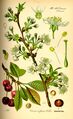 Illustration of Prunus cerasus
 -
 Urschwyzer Kirsch


Medical Disclaimer: WikiMD is for informational purposes only and is not a substitute for professional medical advice. Content may be inaccurate or outdated and should not be used for diagnosis or treatment. Always consult your healthcare provider for medical decisions. Verify information with trusted sources such as CDC.gov and NIH.gov. By using this site, you agree that WikiMD is not liable for any outcomes related to its content. See full disclaimer.
Credits:Most images are courtesy of Wikimedia commons, and templates, categories Wikipedia, licensed under CC BY SA or similar.
Translate page: - East Asian
中文,
日本,
한국어,
South Asian
हिन्दी,
தமிழ்,
తెలుగు,
Urdu,
ಕನ್ನಡ,
Southeast Asian
Indonesian,
Vietnamese,
Thai,
မြန်မာဘာသာ,
বাংলা
European
español,
Deutsch,
français,
Greek,
português do Brasil,
polski,
română,
русский,
Nederlands,
norsk,
svenska,
suomi,
Italian
Middle Eastern & African
عربى,
Turkish,
Persian,
Hebrew,
Afrikaans,
isiZulu,
Kiswahili,
Other
Bulgarian,
Hungarian,
Czech,
Swedish,
മലയാളം,
मराठी,
ਪੰਜਾਬੀ,
ગુજરાતી,
Portuguese,
Ukrainian

