Pyknosis
Pyknosis is a term used in cell biology to describe the irreversible condensation of chromatin in the nucleus of a cell undergoing apoptosis or necrosis. This process is a hallmark of cell death and is often observed in cells that are no longer viable.
Characteristics[edit]
During pyknosis, the chromatin condenses into a dense, compact mass. This is typically followed by the fragmentation of the nucleus, a process known as karyorrhexis. Pyknosis is one of the key morphological changes that occur during apoptosis, along with cell shrinkage, membrane blebbing, and the formation of apoptotic bodies.
Causes[edit]
Pyknosis can be triggered by various factors, including:
Detection[edit]
Pyknosis can be detected using various staining techniques in histology, such as H&E staining. Under a microscope, pyknotic nuclei appear as small, darkly stained masses within the cell.
Significance[edit]
The presence of pyknotic nuclei is an important indicator of cell death and is used in both clinical pathology and research to assess the extent of tissue damage or the effectiveness of therapeutic interventions.
Related Processes[edit]
See Also[edit]
References[edit]
External Links[edit]

 | This medical article is a stub. You can help WikiMD by expanding the page. |
Pyknosis[edit]
-
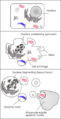 Apoptosis
 -
4 Bd obs 4 680x512px
-
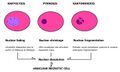 Nuclear changes
 -
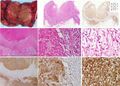 Histopathology of a pheochromocytoma with coagulative necrosis, with immunostaining
 -
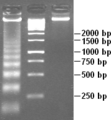 Apoptotic DNA Laddering


Medical Disclaimer: WikiMD is for informational purposes only and is not a substitute for professional medical advice. Content may be inaccurate or outdated and should not be used for diagnosis or treatment. Always consult your healthcare provider for medical decisions. Verify information with trusted sources such as CDC.gov and NIH.gov. By using this site, you agree that WikiMD is not liable for any outcomes related to its content. See full disclaimer.
Credits:Most images are courtesy of Wikimedia commons, and templates, categories Wikipedia, licensed under CC BY SA or similar.
Translate this page: - East Asian
中文,
日本,
한국어,
South Asian
हिन्दी,
தமிழ்,
తెలుగు,
Urdu,
ಕನ್ನಡ,
Southeast Asian
Indonesian,
Vietnamese,
Thai,
မြန်မာဘာသာ,
বাংলা
European
español,
Deutsch,
français,
Greek,
português do Brasil,
polski,
română,
русский,
Nederlands,
norsk,
svenska,
suomi,
Italian
Middle Eastern & African
عربى,
Turkish,
Persian,
Hebrew,
Afrikaans,
isiZulu,
Kiswahili,
Other
Bulgarian,
Hungarian,
Czech,
Swedish,
മലയാളം,
मराठी,
ਪੰਜਾਬੀ,
ગુજરાતી,
Portuguese,
Ukrainian

