Interthalamic adhesion
Anatomical feature of the brain
[[File: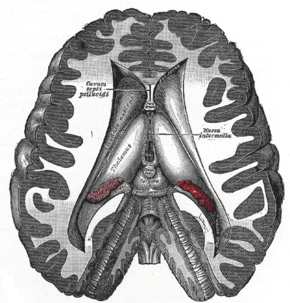 |frameless|alt=]]

| Details | |
|---|---|
| Synonyms | |
| Pronunciation | |
| Carnegie stage | |
| Days | |
| Precursor | |
| Gives rise to | |
| Part of | |
The interthalamic adhesion, also known as the massa intermedia, is a small, midline structure in the human brain that connects the two thalami across the third ventricle. It is not present in all individuals and its function remains somewhat unclear.
Anatomy[edit]
The interthalamic adhesion is a flattened band of tissue that extends across the third ventricle, connecting the medial surfaces of the left and right thalami. It is composed of gray matter and is located near the center of the brain. The size and presence of the interthalamic adhesion can vary significantly among individuals; in some people, it is absent altogether.
Function[edit]
The precise function of the interthalamic adhesion is not well understood. It is generally considered to be a non-functional structure, as its absence does not appear to affect brain function. Some researchers suggest that it may play a role in the synchronization of thalamic activity between the two hemispheres, but this hypothesis requires further investigation.
Clinical significance[edit]
The interthalamic adhesion is often noted in neuroimaging studies, such as MRI, due to its location and appearance. Its presence or absence can be used as a reference point in brain imaging, but it is not typically associated with any specific clinical conditions.
Development[edit]
The development of the interthalamic adhesion occurs during fetal growth, but the factors that determine its presence or size are not well understood. It is thought to form as the thalami develop and grow towards each other during brain development.
Also see[edit]
References[edit]
- Susan,
 Gray's Anatomy: The Anatomical Basis of Clinical Practice,
 41st edition,
 Elsevier,
 2016,


 ISBN 978-0-7020-5230-9,
- "The Thalamus".Neuroscience.2007;145(3)
- 567–582.doi:10.1016/j.neuroscience.2006.12.002.

Medical Disclaimer: WikiMD is for informational purposes only and is not a substitute for professional medical advice. Content may be inaccurate or outdated and should not be used for diagnosis or treatment. Always consult your healthcare provider for medical decisions. Verify information with trusted sources such as CDC.gov and NIH.gov. By using this site, you agree that WikiMD is not liable for any outcomes related to its content. See full disclaimer.
Credits:Most images are courtesy of Wikimedia commons, and templates, categories Wikipedia, licensed under CC BY SA or similar.
Translate page: - East Asian
中文,
日本,
한국어,
South Asian
हिन्दी,
தமிழ்,
తెలుగు,
Urdu,
ಕನ್ನಡ,
Southeast Asian
Indonesian,
Vietnamese,
Thai,
မြန်မာဘာသာ,
বাংলা
European
español,
Deutsch,
français,
Greek,
português do Brasil,
polski,
română,
русский,
Nederlands,
norsk,
svenska,
suomi,
Italian
Middle Eastern & African
عربى,
Turkish,
Persian,
Hebrew,
Afrikaans,
isiZulu,
Kiswahili,
Other
Bulgarian,
Hungarian,
Czech,
Swedish,
മലയാളം,
मराठी,
ਪੰਜਾਬੀ,
ગુજરાતી,
Portuguese,
Ukrainian

