Intercrural fibres of superficial inguinal ring
Anatomical feature of the inguinal region
[[File: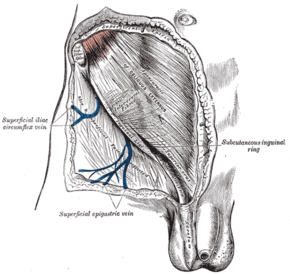 |frameless|alt=]]

| Details | |
|---|---|
| Synonyms | |
| Pronunciation | |
| Carnegie stage | |
| Days | |
| Precursor | |
| Gives rise to | |
| Part of | |
The intercrural fibres of the superficial inguinal ring are connective tissue fibers that play a crucial role in the structural integrity of the inguinal canal. These fibers are part of the external oblique muscle's aponeurosis and are located in the lower anterior abdominal wall.
Anatomy[edit]
The superficial inguinal ring is an opening in the aponeurosis of the external oblique muscle, which forms the anterior wall of the inguinal canal. The intercrural fibres are situated above this opening and serve to reinforce the margins of the ring, preventing it from tearing or widening excessively.
The intercrural fibres run obliquely and horizontally, interconnecting the two crura (medial and lateral) of the superficial inguinal ring. These fibers help maintain the shape and size of the ring, which is essential for the passage of structures such as the spermatic cord in males and the round ligament of the uterus in females.
Function[edit]
The primary function of the intercrural fibres is to provide support and stability to the superficial inguinal ring. By reinforcing the ring, these fibers help prevent inguinal hernias, which occur when abdominal contents protrude through a weakened area of the abdominal wall.
Clinical significance[edit]
Weakness or damage to the intercrural fibres can lead to an increased risk of inguinal hernias. Surgical procedures that repair hernias often involve reinforcing the area around the superficial inguinal ring, sometimes using mesh to provide additional support.
Also see[edit]


Medical Disclaimer: WikiMD is for informational purposes only and is not a substitute for professional medical advice. Content may be inaccurate or outdated and should not be used for diagnosis or treatment. Always consult your healthcare provider for medical decisions. Verify information with trusted sources such as CDC.gov and NIH.gov. By using this site, you agree that WikiMD is not liable for any outcomes related to its content. See full disclaimer.
Credits:Most images are courtesy of Wikimedia commons, and templates, categories Wikipedia, licensed under CC BY SA or similar.
Translate page: - East Asian
中文,
日本,
한국어,
South Asian
हिन्दी,
தமிழ்,
తెలుగు,
Urdu,
ಕನ್ನಡ,
Southeast Asian
Indonesian,
Vietnamese,
Thai,
မြန်မာဘာသာ,
বাংলা
European
español,
Deutsch,
français,
Greek,
português do Brasil,
polski,
română,
русский,
Nederlands,
norsk,
svenska,
suomi,
Italian
Middle Eastern & African
عربى,
Turkish,
Persian,
Hebrew,
Afrikaans,
isiZulu,
Kiswahili,
Other
Bulgarian,
Hungarian,
Czech,
Swedish,
മലയാളം,
मराठी,
ਪੰਜਾਬੀ,
ગુજરાતી,
Portuguese,
Ukrainian

