Infraorbital foramen
Infraorbital foramen is an anatomical feature in the skull of both humans and various animal species. It is an opening located in the maxilla, one of the facial bones, just below the infraorbital margin of the eye socket.
Etymology[edit]
The term "infraorbital foramen" is derived from the Latin words "infra", meaning below, and "orbital", referring to the eye socket. "Foramen" is a Latin word meaning hole or opening.
Anatomy[edit]
The infraorbital foramen is an important landmark in both human and veterinary anatomy. It allows passage of the infraorbital nerve, artery, and vein, which provide sensation to the lower eyelid, upper lip, and part of the nasal cavity.
In humans, the infraorbital foramen is typically located about 1 cm below the infraorbital margin. In other animals, the location can vary. For example, in dogs and cats, the infraorbital foramen is located more rostrally, near the third upper premolar tooth.
Clinical significance[edit]
Knowledge of the location of the infraorbital foramen is important in various medical and dental procedures. For example, it is a landmark for infraorbital nerve block, a type of local anesthesia used in dental surgery. It can also be a site of injury in facial trauma.
Related terms[edit]
- Infraorbital nerve: The nerve that passes through the infraorbital foramen.
- Maxilla: The bone in which the infraorbital foramen is located.
- Foramen: A general term for an opening or hole in the body.
See also[edit]

This WikiMD article can only be edited by registered and verified editors. You can log in or register.
-
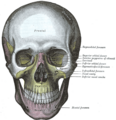 Infraorbital foramen in human skull
 -
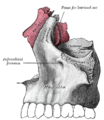 Anatomy of the human skull showing infraorbital foramen
 -
Grizzly bear skull with visible infraorbital foramen
-
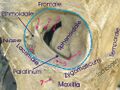 Human skull orbit showing infraorbital foramen


Advertise on WikiMD — 81,000+ full articles, ~900,000 total pages, ~250 million page views. Global reach, limited time promotional rates from $1/page/day. Learn more · View stats


Translate page: - East Asian
中文,
日本,
한국어,
South Asian
हिन्दी,
தமிழ்,
తెలుగు,
Urdu,
ಕನ್ನಡ,
Southeast Asian
Indonesian,
Vietnamese,
Thai,
မြန်မာဘာသာ,
বাংলা
European
español,
Deutsch,
français,
Greek,
português do Brasil,
polski,
română,
русский,
Nederlands,
norsk,
svenska,
suomi,
Italian
Middle Eastern & African
عربى,
Turkish,
Persian,
Hebrew,
Afrikaans,
isiZulu,
Kiswahili,
Other
Bulgarian,
Hungarian,
Czech,
Swedish,
മലയാളം,
मराठी,
ਪੰਜਾਬੀ,
ગુજરાતી,
Portuguese,
Ukrainian
About WikiMD • Contact • Disclaimer • Privacy • Copyright • Site statistics
Some content and images may originate from Wikimedia Commons or Wikipedia and remain subject to their stated licenses. Unless otherwise noted, eligible WikiMD content is available under CC BY-SA 4.0.
WikiMD Wellnesspedia — Free health & wellness information for patients, students, and health professionals.


