Infraglenoid tubercle
Infraglenoid tubercle is a part of the scapula, or shoulder blade, in the human body. It is a small bony prominence located on the lateral border of the scapula, just below the glenoid cavity, which is the socket that holds the head of the humerus bone to form the shoulder joint.
Etymology[edit]
The term "infraglenoid" is derived from the Latin words "infra", meaning below, and "glenoid", referring to the glenoid cavity. "Tubercle" is a term used in anatomy to describe a small, rounded prominence on a bone.
Anatomy[edit]
The infraglenoid tubercle serves as the point of attachment for the long head of the triceps brachii muscle, one of the major muscles of the arm. This muscle plays a key role in the extension of the forearm at the elbow joint and the adduction and extension of the arm at the shoulder joint.
Clinical significance[edit]
Due to its role as an attachment point for the triceps brachii, injuries or conditions that affect the infraglenoid tubercle can impact the function of this muscle and thus the movement of the arm and forearm. For example, fractures of the scapula that involve the infraglenoid tubercle may result in weakness or loss of function in the triceps brachii.
See also[edit]
References[edit]

This WikiMD article can only be edited by registered and verified editors. You can log in or register.
Infraglenoid_tubercle[edit]
-
Lateral view of left scapula highlighting the infraglenoid tubercle
-
Animation showing the infraglenoid tubercle of the left scapula
-
Animation of the infraglenoid tubercle of the scapula
-
Infraglenoid tubercle of left scapula
-
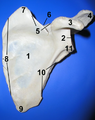 Anterior view of scapula with numbered parts
 -
Infraglenoid tubercle of left scapula

Advertise on WikiMD — 81,000+ full articles, ~900,000 total pages, ~250 million page views. Global reach, limited time promotional rates from $1/page/day. Learn more · View stats

Translate page: - East Asian
中文,
日本,
한국어,
South Asian
हिन्दी,
தமிழ்,
తెలుగు,
Urdu,
ಕನ್ನಡ,
Southeast Asian
Indonesian,
Vietnamese,
Thai,
မြန်မာဘာသာ,
বাংলা
European
español,
Deutsch,
français,
Greek,
português do Brasil,
polski,
română,
русский,
Nederlands,
norsk,
svenska,
suomi,
Italian
Middle Eastern & African
عربى,
Turkish,
Persian,
Hebrew,
Afrikaans,
isiZulu,
Kiswahili,
Other
Bulgarian,
Hungarian,
Czech,
Swedish,
മലയാളം,
मराठी,
ਪੰਜਾਬੀ,
ગુજરાતી,
Portuguese,
Ukrainian
About WikiMD • Contact • Disclaimer • Privacy • Copyright • Site statistics
Some content and images may originate from Wikimedia Commons or Wikipedia and remain subject to their stated licenses. Unless otherwise noted, eligible WikiMD content is available under CC BY-SA 4.0.
WikiMD Wellnesspedia — Free health & wellness information for patients, students, and health professionals.


