Imleria badia
Imleria badia, also known as the Bay Bolete, is a common, edible, pored mushroom from the family Boletaceae. It is found across Europe and North America, and is known for its distinctive bay-brown color.
Taxonomy[edit]
The species was first described scientifically by Carl Linnaeus in 1753, as Boletus badius. The specific epithet badia refers to the bay-brown color of the cap. The mushroom was transferred to the new genus Imleria in 2014.
Description[edit]
The cap of Imleria badia can reach up to 20 cm (8 in) in diameter. It is initially convex, but flattens with age. The surface is smooth and bay-brown, often with a slightly darker center. The flesh is white, but stains blue when cut or bruised.
The tubes and pores are initially white, but become yellowish with age. The stem is cylindrical, often with a swollen base, and is covered with a fine, white net-like pattern.
Distribution and habitat[edit]
Imleria badia is widely distributed in the Northern Hemisphere, including Europe and North America. It is found in both coniferous and deciduous forests, often in association with spruce and pine. It fruits from summer to autumn.
Edibility[edit]
Imleria badia is considered a good edible mushroom. It has a pleasant, mild taste and a firm texture. It is suitable for drying, and can be used in a variety of dishes.
See also[edit]
References[edit]


Imleria badia[edit]
-
Imleria badia mushroom in the forest
-
Close-up of Imleria badia cap
-
Imleria badia growing in moss
-
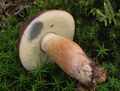 Imleria badia with visible pores
 -
Imleria badia in natural habitat
-
Dried Imleria badia mushrooms

Advertise on WikiMD — 81,000+ full articles, ~900,000 total pages, ~250 million page views. Global reach, limited time promotional rates from $1/page/day. Learn more · View stats

Translate page: - East Asian
中文,
日本,
한국어,
South Asian
हिन्दी,
தமிழ்,
తెలుగు,
Urdu,
ಕನ್ನಡ,
Southeast Asian
Indonesian,
Vietnamese,
Thai,
မြန်မာဘာသာ,
বাংলা
European
español,
Deutsch,
français,
Greek,
português do Brasil,
polski,
română,
русский,
Nederlands,
norsk,
svenska,
suomi,
Italian
Middle Eastern & African
عربى,
Turkish,
Persian,
Hebrew,
Afrikaans,
isiZulu,
Kiswahili,
Other
Bulgarian,
Hungarian,
Czech,
Swedish,
മലയാളം,
मराठी,
ਪੰਜਾਬੀ,
ગુજરાતી,
Portuguese,
Ukrainian
About WikiMD • Contact • Disclaimer • Privacy • Copyright • Site statistics
Some content and images may originate from Wikimedia Commons or Wikipedia and remain subject to their stated licenses. Unless otherwise noted, eligible WikiMD content is available under CC BY-SA 4.0.
WikiMD Wellnesspedia — Free health & wellness information for patients, students, and health professionals.


