I-cell
I-cell disease, also known as Mucolipidosis II, is a rare lysosomal storage disease characterized by severe psychomotor impairment and skeletal abnormalities. It is caused by a deficiency in the enzyme N-acetylglucosamine-1-phosphotransferase, which leads to improper processing and distribution of lysosomal enzymes.
Symptoms and Signs[edit]
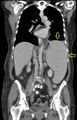
The symptoms of I-cell disease are typically present at birth and may include growth retardation, coarse facial features, gingival hypertrophy, and skeletal deformities. Other symptoms may include cardiomegaly, hepatomegaly, splenomegaly, and hernias.
Cause[edit]
I-cell disease is caused by mutations in the GNPTAB gene, which provides instructions for making the alpha and beta subunits of the enzyme N-acetylglucosamine-1-phosphotransferase. This enzyme is responsible for adding a molecule called mannose-6-phosphate to certain proteins, which directs these proteins to lysosomes. Without this tag, these proteins are secreted outside the cell instead of being transported to lysosomes, leading to the symptoms of I-cell disease.
Diagnosis[edit]
Diagnosis of I-cell disease is based on clinical findings, enzyme assays showing deficient activity of multiple lysosomal enzymes, and molecular genetic testing of the GNPTAB gene.
Treatment[edit]
There is currently no cure for I-cell disease, and treatment is supportive. Management may include physical therapy to improve mobility and speech therapy to address feeding difficulties.
Prognosis[edit]
The prognosis for individuals with I-cell disease is poor, with most individuals not surviving past early childhood due to respiratory infections or cardiac complications.
See also[edit]

This WikiMD article can only be edited by registered and verified editors. You can log in or register.
-
I-cell
-
 I-cell
 -
 I-cell
.jpg)


Medical Disclaimer: WikiMD is for informational purposes only and is not a substitute for professional medical advice. Content may be inaccurate or outdated and should not be used for diagnosis or treatment. Always consult your healthcare provider for medical decisions. Verify information with trusted sources such as CDC.gov and NIH.gov. By using this site, you agree that WikiMD is not liable for any outcomes related to its content. See full disclaimer.
Credits:Most images are courtesy of Wikimedia commons, and templates, categories Wikipedia, licensed under CC BY SA or similar.
Translate page: - East Asian
中文,
日本,
한국어,
South Asian
हिन्दी,
தமிழ்,
తెలుగు,
Urdu,
ಕನ್ನಡ,
Southeast Asian
Indonesian,
Vietnamese,
Thai,
မြန်မာဘာသာ,
বাংলা
European
español,
Deutsch,
français,
Greek,
português do Brasil,
polski,
română,
русский,
Nederlands,
norsk,
svenska,
suomi,
Italian
Middle Eastern & African
عربى,
Turkish,
Persian,
Hebrew,
Afrikaans,
isiZulu,
Kiswahili,
Other
Bulgarian,
Hungarian,
Czech,
Swedish,
മലയാളം,
मराठी,
ਪੰਜਾਬੀ,
ગુજરાતી,
Portuguese,
Ukrainian


