Hypromellose
Hypromellose (short for hydroxypropyl methylcellulose), also known as HPMC, is a semisynthetic, inert, viscoelastic polymer used as an eye lubricant, as well as an excipient and controlled-delivery component in oral medicaments, found in a variety of commercial products.
Etymology[edit]
The term "Hypromellose" is derived from the words "hydroxypropyl methylcellulose". "Hydroxypropyl" refers to the hydroxypropyl groups that are attached to the cellulose backbone. "Methylcellulose" refers to the methyl groups that are also attached to the cellulose backbone.
Uses[edit]
As an excipient, it is used to improve the emulsification and suspension of pharmaceutical ingredients in oral liquid and semi-solid formulations. It is also used as a controlled-release component in oral dosage forms to modulate drug release profiles and to minimize drug waste.
As an eye lubricant, it is used to relieve dryness and irritation caused by reduced tear flow. It works by forming a protective layer over the eye and trapping moisture.
Related Terms[edit]
- Hydroxypropyl group
- Methylcellulose
- Excipient
- Emulsification
- Suspension
- Oral
- Dosage form
- Eye lubricant
See Also[edit]

This WikiMD article can only be edited by registered and verified editors. You can log in or register.
-
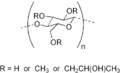 Hypromellose


Medical Disclaimer: WikiMD is for informational purposes only and is not a substitute for professional medical advice. Content may be inaccurate or outdated and should not be used for diagnosis or treatment. Always consult your healthcare provider for medical decisions. Verify information with trusted sources such as CDC.gov and NIH.gov. By using this site, you agree that WikiMD is not liable for any outcomes related to its content. See full disclaimer.
Credits:Most images are courtesy of Wikimedia commons, and templates, categories Wikipedia, licensed under CC BY SA or similar.
Translate page: - East Asian
中文,
日本,
한국어,
South Asian
हिन्दी,
தமிழ்,
తెలుగు,
Urdu,
ಕನ್ನಡ,
Southeast Asian
Indonesian,
Vietnamese,
Thai,
မြန်မာဘာသာ,
বাংলা
European
español,
Deutsch,
français,
Greek,
português do Brasil,
polski,
română,
русский,
Nederlands,
norsk,
svenska,
suomi,
Italian
Middle Eastern & African
عربى,
Turkish,
Persian,
Hebrew,
Afrikaans,
isiZulu,
Kiswahili,
Other
Bulgarian,
Hungarian,
Czech,
Swedish,
മലയാളം,
मराठी,
ਪੰਜਾਬੀ,
ગુજરાતી,
Portuguese,
Ukrainian

