Hyaloid canal
The Hyaloid Canal, also known as Cloquet's Canal or Stilling's Canal, is a small, narrow passage in the vitreous humor of the eye. It is a remnant of the fetal circulatory system and extends from the optic disc to the posterior surface of the lens.
Etymology[edit]
The term "hyaloid" is derived from the Greek words "hyalos", meaning glass, and "eidos", meaning form or shape. This is in reference to the transparent nature of the vitreous humor where the canal is located. The canal is also named after Jules Germain Cloquet, a French anatomist, and Benjamin Stilling, a German anatomist, who both made significant contributions to the understanding of this structure.
Structure and Function[edit]
The Hyaloid Canal is a slender, thread-like structure that runs through the center of the vitreous body, a clear gel that fills the space between the lens and the retina in the eye. It is a remnant of the hyaloid artery, which supplies blood to the developing lens in the fetus. After birth, the hyaloid artery regresses and typically disappears, but the empty canal often remains.
Clinical Significance[edit]
In some cases, remnants of the hyaloid artery can persist after birth, a condition known as Persistent Hyaloid Artery. This can lead to various ocular complications, including cataracts, glaucoma, and retinal detachment.
Related Terms[edit]
- Vitreous Humor: The clear gel that fills the space between the lens and the retina in the eye.
- Optic Disc: The point of exit for ganglion cell axons leaving the eye.
- Lens (anatomy): The transparent biconvex structure in the eye that, along with the cornea, helps to refract light to be focused on the retina.
- Retina: The innermost, light-sensitive layer of tissue of the eye.

This WikiMD article can only be edited by registered and verified editors. You can log in or register.
-
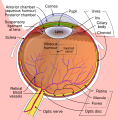 Schematic diagram of the human eye


Medical Disclaimer: WikiMD is for informational purposes only and is not a substitute for professional medical advice. Content may be inaccurate or outdated and should not be used for diagnosis or treatment. Always consult your healthcare provider for medical decisions. Verify information with trusted sources such as CDC.gov and NIH.gov. By using this site, you agree that WikiMD is not liable for any outcomes related to its content. See full disclaimer.
Credits:Most images are courtesy of Wikimedia commons, and templates, categories Wikipedia, licensed under CC BY SA or similar.
Translate page: - East Asian
中文,
日本,
한국어,
South Asian
हिन्दी,
தமிழ்,
తెలుగు,
Urdu,
ಕನ್ನಡ,
Southeast Asian
Indonesian,
Vietnamese,
Thai,
မြန်မာဘာသာ,
বাংলা
European
español,
Deutsch,
français,
Greek,
português do Brasil,
polski,
română,
русский,
Nederlands,
norsk,
svenska,
suomi,
Italian
Middle Eastern & African
عربى,
Turkish,
Persian,
Hebrew,
Afrikaans,
isiZulu,
Kiswahili,
Other
Bulgarian,
Hungarian,
Czech,
Swedish,
മലയാളം,
मराठी,
ਪੰਜਾਬੀ,
ગુજરાતી,
Portuguese,
Ukrainian

