Hyaline cartilage
Hyaline Cartilage is a type of cartilage found in areas such as the joints, respiratory tract, and nasal septum. It is the most common type of cartilage and is characterized by its glassy, shiny appearance.
Structure[edit]
Hyaline cartilage is composed of a dense network of collagen fibers, proteoglycans, and chondrocytes. The chondrocytes are responsible for the production of the extracellular matrix, which gives the cartilage its unique properties.
Function[edit]
The primary function of hyaline cartilage is to provide a smooth, lubricated surface for articulation and to facilitate the movement of the joints. It also serves as a flexible yet supportive structure in the respiratory tract and nasal septum.
Clinical Significance[edit]
Damage to the hyaline cartilage can lead to conditions such as osteoarthritis, which is characterized by the degeneration of cartilage in the joints. In addition, abnormalities in the development of hyaline cartilage can result in conditions such as achondroplasia, a form of short-limbed dwarfism.
See Also[edit]
References[edit]

This WikiMD article can only be edited by registered and verified editors. You can log in or register.
-
Histology of articular cartilage zones
-
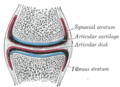 Hyaline cartilage

Advertise on WikiMD — 81,000+ full articles, ~900,000 total pages, ~250 million page views. Global reach, limited time promotional rates from $1/page/day. Learn more · View stats

Translate page: - East Asian
中文,
日本,
한국어,
South Asian
हिन्दी,
தமிழ்,
తెలుగు,
Urdu,
ಕನ್ನಡ,
Southeast Asian
Indonesian,
Vietnamese,
Thai,
မြန်မာဘာသာ,
বাংলা
European
español,
Deutsch,
français,
Greek,
português do Brasil,
polski,
română,
русский,
Nederlands,
norsk,
svenska,
suomi,
Italian
Middle Eastern & African
عربى,
Turkish,
Persian,
Hebrew,
Afrikaans,
isiZulu,
Kiswahili,
Other
Bulgarian,
Hungarian,
Czech,
Swedish,
മലയാളം,
मराठी,
ਪੰਜਾਬੀ,
ગુજરાતી,
Portuguese,
Ukrainian
About WikiMD • Contact • Disclaimer • Privacy • Copyright • Site statistics
Some content and images may originate from Wikimedia Commons or Wikipedia and remain subject to their stated licenses. Unless otherwise noted, eligible WikiMD content is available under CC BY-SA 4.0.
WikiMD Wellnesspedia — Free health & wellness information for patients, students, and health professionals.


