Human tooth development
Human tooth development or odontogenesis is the complex process by which teeth form from embryonic cells, grow, and erupt into the mouth. For human teeth to have a healthy oral environment, all parts of the tooth must develop during appropriate stages of fetal development. Primary (baby) teeth start to form between the sixth and eighth week of prenatal development, and permanent teeth begin to form in the twentieth week.
Stages of Tooth Development[edit]
Tooth development is commonly divided into the following stages: the bud stage, the cap stage, the bell stage, and finally maturation.
Bud Stage[edit]
The initial stage of tooth development is the bud stage. This stage is characterized by the formation of a tooth bud without any clear organization. The tooth bud is an aggregation of cells that eventually forms a tooth. It is the first sign of tooth development and it occurs in the dental lamina.
Cap Stage[edit]
The cap stage follows the bud stage. It is named for the cap-like appearance of the developing tooth. During this stage, the cells of the tooth bud divide and are differentiated into specific tooth cell types.
Bell Stage[edit]
The bell stage is the third stage of tooth development. During this stage, the tooth shape is fully formed, and the different cell types continue to differentiate and develop.
Maturation Stage[edit]
The final stage of tooth development is the maturation stage. During this stage, the tooth hardens and the cells within the tooth become fully differentiated. This stage continues until the tooth erupts into the mouth.
Tooth Eruption[edit]
Tooth eruption is the process by which a tooth enters the mouth and becomes visible. It is not the same as tooth growth, which is the formation of the tooth itself.
See Also[edit]
References[edit]

Human_tooth_development[edit]
-
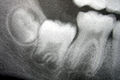 Molars in development
 -
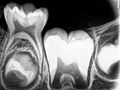 Intraoral Periapical Radiograph (IOPA) showing Deciduous (Milky or Primary) Tooth 75 and developing crown of Permanent or Secondary Teeth 35, 36 and 37
 -
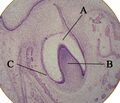 Tooth bud labeled
 -
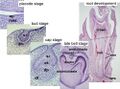 Histology of important stages of tooth development
 -
 Tooth bud annotated
 -
 Cap stage
 -
 Early bell stage
 -
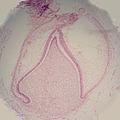 Late bell stage

_showing_Deciduous(Milky_or_Primary)_Tooth_75_and_developing_crown_of_Permanent_or_Secondary_Teeth_35,_36_and_37.jpg)


Medical Disclaimer: WikiMD is for informational purposes only and is not a substitute for professional medical advice. Content may be inaccurate or outdated and should not be used for diagnosis or treatment. Always consult your healthcare provider for medical decisions. Verify information with trusted sources such as CDC.gov and NIH.gov. By using this site, you agree that WikiMD is not liable for any outcomes related to its content. See full disclaimer.
Credits:Most images are courtesy of Wikimedia commons, and templates, categories Wikipedia, licensed under CC BY SA or similar.
Translate page: - East Asian
中文,
日本,
한국어,
South Asian
हिन्दी,
தமிழ்,
తెలుగు,
Urdu,
ಕನ್ನಡ,
Southeast Asian
Indonesian,
Vietnamese,
Thai,
မြန်မာဘာသာ,
বাংলা
European
español,
Deutsch,
français,
Greek,
português do Brasil,
polski,
română,
русский,
Nederlands,
norsk,
svenska,
suomi,
Italian
Middle Eastern & African
عربى,
Turkish,
Persian,
Hebrew,
Afrikaans,
isiZulu,
Kiswahili,
Other
Bulgarian,
Hungarian,
Czech,
Swedish,
മലയാളം,
मराठी,
ਪੰਜਾਬੀ,
ગુજરાતી,
Portuguese,
Ukrainian

