Hatha yoga
Hatha Yoga is a branch of Yoga that emphasizes physical exercises to master the body along with mind exercises to withdraw it from external objects. The word "Hatha" means force in Sanskrit, which refers to the physical techniques in Hatha Yoga. This practice is designed to align and calm your body, mind, and spirit in preparation for meditation.
Origins and History[edit]
Hatha Yoga has its origins in ancient India. It is difficult to pinpoint the exact date of Hatha Yoga's beginnings, but it is often associated with early Hindu texts and, later, Buddhist practices. The earliest references to Hatha Yoga are found in the 11th-century CE, in texts such as the Hatha Yoga Pradipika, written by Swami Swatmarama, the Gheranda Samhita, and the Shiva Samhita. These texts detail the techniques of Hatha Yoga, including asanas (physical postures), pranayama (breath control), mudras (gestures), and bandhas (energy locks).
Philosophy[edit]
The philosophy of Hatha Yoga is rooted in dualism, which sees the body and mind as separate entities that can be brought into harmony through practice. The ultimate goal of Hatha Yoga is to achieve Samadhi (a state of intense concentration) and to awaken the Kundalini energy that lies dormant at the base of the spine. This is believed to lead to spiritual enlightenment and liberation (Moksha).
Practice[edit]
Hatha Yoga practice involves a series of physical postures (asanas), breathing techniques (pranayama), and meditation (dhyana). The asanas are designed to open the channels of the body so that energy can flow freely. Pranayama practices are used to control the breath, which is believed to be the source of life energy (Prana). Meditation is used to calm and focus the mind.
Asanas[edit]
Asanas are the physical postures of Hatha Yoga. They range from simple poses that can be done by beginners to complex poses that require years of practice. Each asana has specific benefits for the body and mind, such as improving flexibility, strength, balance, and mental concentration.
Pranayama[edit]
Pranayama involves the control of breath. The practice is believed to help regulate the flow of prana within the body, leading to improved health and well-being. There are various pranayama techniques, each with its own specific benefits.
Meditation[edit]
Meditation is an essential part of Hatha Yoga. It involves focusing the mind on a single point of reference, such as the breath or a mantra, to achieve a state of deep concentration and relaxation.
Benefits[edit]
Hatha Yoga offers numerous physical and mental benefits, including increased flexibility, strength, and balance; improved respiratory and cardiovascular health; stress relief; and enhanced mental clarity and concentration.
Modern Practice[edit]
Today, Hatha Yoga is practiced worldwide as a form of physical exercise and stress management. It has been adapted in various ways to suit the needs of modern practitioners, but the core principles and techniques remain the same.
See Also[edit]
 | This medical article is a stub. You can help WikiMD by expanding the page. |
-
 Hatha Yoga Components
 -
 Практика туммо
 -
 Amritasiddhi Witness C Folio IV
 -
 Early Bindu Model of Hatha Yoga
 -
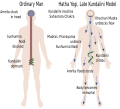 Late Kundalini Model of Hatha Yoga
 -
 Female Ascetics (Yoginis)
 -
 Kailash Integral Yoga
 -
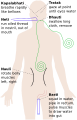 Shatkarmas
 -
 Siddhasana mulher
 -
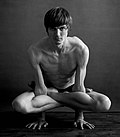 Yoga shaktipat kukkutasana by Alexey Baykov
 -
 Mode of action of Mudras


_LACMA_M.2011.156.4_(1_of_2).jpg)


Medical Disclaimer: WikiMD is for informational purposes only and is not a substitute for professional medical advice. Content may be inaccurate or outdated and should not be used for diagnosis or treatment. Always consult your healthcare provider for medical decisions. Verify information with trusted sources such as CDC.gov and NIH.gov. By using this site, you agree that WikiMD is not liable for any outcomes related to its content. See full disclaimer.
Credits:Most images are courtesy of Wikimedia commons, and templates, categories Wikipedia, licensed under CC BY SA or similar.
Translate page: - East Asian
中文,
日本,
한국어,
South Asian
हिन्दी,
தமிழ்,
తెలుగు,
Urdu,
ಕನ್ನಡ,
Southeast Asian
Indonesian,
Vietnamese,
Thai,
မြန်မာဘာသာ,
বাংলা
European
español,
Deutsch,
français,
Greek,
português do Brasil,
polski,
română,
русский,
Nederlands,
norsk,
svenska,
suomi,
Italian
Middle Eastern & African
عربى,
Turkish,
Persian,
Hebrew,
Afrikaans,
isiZulu,
Kiswahili,
Other
Bulgarian,
Hungarian,
Czech,
Swedish,
മലയാളം,
मराठी,
ਪੰਜਾਬੀ,
ગુજરાતી,
Portuguese,
Ukrainian

