Hangtown fry
Hanger Reflex
The Hanger Reflex is a physiological phenomenon that was first discovered and described by Japanese researcher Yoshiro Tsutsumi in 2007. This reflex is a unique response of the human body to the application of a hanger on the ear, which results in the head tilting towards the side of the hanger's application.
Mechanism[edit]
The Hanger Reflex is believed to be a result of the pressure applied by the hanger on the auricle of the ear. This pressure stimulates the auriculotemporal nerve, a branch of the trigeminal nerve, which is responsible for the sensation in the ear. The stimulation of this nerve sends signals to the brain, causing the head to tilt towards the side of the hanger's application.
Applications[edit]
The Hanger Reflex has been studied for its potential applications in various fields. In physiotherapy, it has been suggested as a possible treatment for torticollis, a condition where the head is tilted to one side. In neurology, it has been proposed as a non-invasive method to study the functioning of the trigeminal nerve.
Research[edit]
Since its discovery, the Hanger Reflex has been the subject of several research studies. These studies have aimed to understand the exact mechanism of the reflex, its potential applications, and its limitations. However, more research is needed to fully understand this unique physiological phenomenon.
See also[edit]

This physiology-related article is a stub. You can help WikiMD by expanding it.
 | This article about a neurology is a stub. You can help WikiMD by expanding the page. |
-
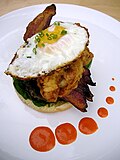 Hangtown Burger

Medical Disclaimer: WikiMD is for informational purposes only and is not a substitute for professional medical advice. Content may be inaccurate or outdated and should not be used for diagnosis or treatment. Always consult your healthcare provider for medical decisions. Verify information with trusted sources such as CDC.gov and NIH.gov. By using this site, you agree that WikiMD is not liable for any outcomes related to its content. See full disclaimer.
Credits:Most images are courtesy of Wikimedia commons, and templates, categories Wikipedia, licensed under CC BY SA or similar.
Translate this page: - East Asian
中文,
日本,
한국어,
South Asian
हिन्दी,
தமிழ்,
తెలుగు,
Urdu,
ಕನ್ನಡ,
Southeast Asian
Indonesian,
Vietnamese,
Thai,
မြန်မာဘာသာ,
বাংলা
European
español,
Deutsch,
français,
Greek,
português do Brasil,
polski,
română,
русский,
Nederlands,
norsk,
svenska,
suomi,
Italian
Middle Eastern & African
عربى,
Turkish,
Persian,
Hebrew,
Afrikaans,
isiZulu,
Kiswahili,
Other
Bulgarian,
Hungarian,
Czech,
Swedish,
മലയാളം,
मराठी,
ਪੰਜਾਬੀ,
ગુજરાતી,
Portuguese,
Ukrainian
