Halspiviridae
Halspiviridae is a family of viruses that infect bacterial hosts, specifically halophilic bacteria. These viruses are characterized by their unique morphology and their ability to survive in high-salt environments.
Taxonomy[edit]
The family Halspiviridae is classified under the order Caudovirales, which includes all tailed bacteriophages. The family is further divided into two genera: Halopanivirinae and Halosiphovirinae. Each genus contains several species of viruses.
Structure[edit]
Viruses in the Halspiviridae family are non-enveloped, with icosahedral and Head-Tail geometries. The diameter is around 60-70 nm. Genomes are linear, around 40-50kb in length. The genome codes for 70-80 proteins.
Life Cycle[edit]
Viral replication is cytoplasmic. Entry into the host cell is achieved by adsorption into the host cell. DNA-templated transcription is the method of transcription. The virus exits the host cell by lysis, and holin/endolysin/spanin proteins are involved. Bacteria serve as the natural host.
Pathogenesis[edit]
The pathogenesis of Halspiviridae is not well understood due to the extreme environments in which their hosts live. However, it is known that they can cause lysis of their host cells, leading to cell death.
Research and Applications[edit]
Research into Halspiviridae is ongoing, with potential applications in biotechnology and environmental science. Due to their ability to survive in high-salt environments, these viruses may be used in the future to control bacterial populations in such environments.
See Also[edit]
References[edit]
<references />
 | This virus-related article is a stub. You can help WikiMD by expanding the page. |
Halspiviridae gallery[edit]
-
 Salterprovirus virion
 -
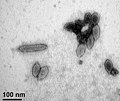 His1 v1


Medical Disclaimer: WikiMD is for informational purposes only and is not a substitute for professional medical advice. Content may be inaccurate or outdated and should not be used for diagnosis or treatment. Always consult your healthcare provider for medical decisions. Verify information with trusted sources such as CDC.gov and NIH.gov. By using this site, you agree that WikiMD is not liable for any outcomes related to its content. See full disclaimer.
Credits:Most images are courtesy of Wikimedia commons, and templates, categories Wikipedia, licensed under CC BY SA or similar.
Translate this page: - East Asian
中文,
日本,
한국어,
South Asian
हिन्दी,
தமிழ்,
తెలుగు,
Urdu,
ಕನ್ನಡ,
Southeast Asian
Indonesian,
Vietnamese,
Thai,
မြန်မာဘာသာ,
বাংলা
European
español,
Deutsch,
français,
Greek,
português do Brasil,
polski,
română,
русский,
Nederlands,
norsk,
svenska,
suomi,
Italian
Middle Eastern & African
عربى,
Turkish,
Persian,
Hebrew,
Afrikaans,
isiZulu,
Kiswahili,
Other
Bulgarian,
Hungarian,
Czech,
Swedish,
മലയാളം,
मराठी,
ਪੰਜਾਬੀ,
ગુજરાતી,
Portuguese,
Ukrainian
