Hairbrush
Hairbrush is a tool with bristles, wire or other filaments, used in hair care for smoothing, styling, and detangling human hair, or for grooming an animal's fur. It can also be used for styling with a hair dryer.
History[edit]
The hairbrush has a long history and has been transformed through numerous patents. Around 1898, Lyda D. Newman, an African-American woman from New York, invented an improved hairbrush design that allowed for easy cleaning and had bristles separated wide enough to efficiently carry out its intended purpose.
Types of Hairbrushes[edit]
There are several types of hairbrushes including the paddle brush, round brush, and the teasing brush. Each type of hairbrush has a unique design that can handle different hair types and lengths, and they are used to achieve different styles.
Paddle Brush[edit]
The Paddle Brush is flat and wide. It is used for straightening and smoothing hair.
Round Brush[edit]
The Round Brush is a cylindrical brush that is used for straightening and curling hair. It is often used with a hair dryer to add volume.
Teasing Brush[edit]
The Teasing Brush is used for backcombing which creates volume. It is smaller in size and has bristles that are close together.
See Also[edit]
References[edit]
<references />
 | |
|---|---|
 |
 |
| This medical article is a stub. You can help Wikipedia by adding missing information. |
-
 Julienne Mathieu having her hair brushed
 -
 Hairbrush flat
 -
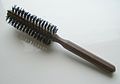 Round hairbrush


Ad. Transform your health with W8MD Weight Loss, Sleep & MedSpa

Tired of being overweight?
Special offer:
Budget GLP-1 weight loss medications
- Semaglutide starting from $29.99/week and up with insurance for visit of $59.99 and up per week self pay.
- Tirzepatide starting from $45.00/week and up (dose dependent) or $69.99/week and up self pay
✔ Same-week appointments, evenings & weekends
Learn more:
- GLP-1 weight loss clinic NYC
- W8MD's NYC medical weight loss
- W8MD Philadelphia GLP-1 shots
- Philadelphia GLP-1 injections
- Affordable GLP-1 shots NYC
- Budget GLP-1 shots
|
WikiMD Medical Encyclopedia |
Medical Disclaimer: WikiMD is for informational purposes only and is not a substitute for professional medical advice. Content may be inaccurate or outdated and should not be used for diagnosis or treatment. Always consult your healthcare provider for medical decisions. Verify information with trusted sources such as CDC.gov and NIH.gov. By using this site, you agree that WikiMD is not liable for any outcomes related to its content. See full disclaimer.
Credits:Most images are courtesy of Wikimedia commons, and templates, categories Wikipedia, licensed under CC BY SA or similar.
Translate this page: - East Asian
中文,
日本,
한국어,
South Asian
हिन्दी,
தமிழ்,
తెలుగు,
Urdu,
ಕನ್ನಡ,
Southeast Asian
Indonesian,
Vietnamese,
Thai,
မြန်မာဘာသာ,
বাংলা
European
español,
Deutsch,
français,
Greek,
português do Brasil,
polski,
română,
русский,
Nederlands,
norsk,
svenska,
suomi,
Italian
Middle Eastern & African
عربى,
Turkish,
Persian,
Hebrew,
Afrikaans,
isiZulu,
Kiswahili,
Other
Bulgarian,
Hungarian,
Czech,
Swedish,
മലയാളം,
मराठी,
ਪੰਜਾਬੀ,
ગુજરાતી,
Portuguese,
Ukrainian
