Guagua longganisa
Guagua longganisa is a type of Filipino longganisa originating from the town of Guagua, Pampanga in the Philippines. It is a variety of sausage known for its distinct garlic flavor, which sets it apart from other types of longganisa in the country.
History[edit]
The history of Guagua longganisa dates back to the Spanish colonial period in the Philippines. The Spanish introduced the concept of sausages to the Filipinos, which was then adapted to local tastes and ingredients, resulting in the creation of longganisa. The town of Guagua, known for its rich culinary tradition, developed its own version of this sausage, which is now known as Guagua longganisa.
Preparation and Ingredients[edit]
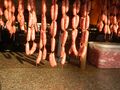
Guagua longganisa is made from ground pork, garlic, vinegar, salt, and pepper. The ground pork is mixed with the other ingredients and then stuffed into hog casings. The sausages are then left to cure for a few days before they are cooked.
Cooking and Serving[edit]
Guagua longganisa is typically cooked by boiling in water until the sausages are cooked through and the water has evaporated. The sausages are then fried in their own fat until they are browned and crispy. Guagua longganisa is often served with rice and a side of vinegar for dipping.
Cultural Significance[edit]
Guagua longganisa is a popular breakfast dish in the Philippines, particularly in the region of Pampanga. It is also a common product in local markets and is often given as a gift or pasalubong to visitors.
See Also[edit]
_-_grilled_saba_bananas_-_01.jpg) | This Filipino cuisine–related article is a stub. You can help WikiMD by expanding the page. |

-
 Candaba, Pampanga Market Fishes Foods Landmarks


Medical Disclaimer: WikiMD is for informational purposes only and is not a substitute for professional medical advice. Content may be inaccurate or outdated and should not be used for diagnosis or treatment. Always consult your healthcare provider for medical decisions. Verify information with trusted sources such as CDC.gov and NIH.gov. By using this site, you agree that WikiMD is not liable for any outcomes related to its content. See full disclaimer.
Credits:Most images are courtesy of Wikimedia commons, and templates, categories Wikipedia, licensed under CC BY SA or similar.
Translate page: - East Asian
中文,
日本,
한국어,
South Asian
हिन्दी,
தமிழ்,
తెలుగు,
Urdu,
ಕನ್ನಡ,
Southeast Asian
Indonesian,
Vietnamese,
Thai,
မြန်မာဘာသာ,
বাংলা
European
español,
Deutsch,
français,
Greek,
português do Brasil,
polski,
română,
русский,
Nederlands,
norsk,
svenska,
suomi,
Italian
Middle Eastern & African
عربى,
Turkish,
Persian,
Hebrew,
Afrikaans,
isiZulu,
Kiswahili,
Other
Bulgarian,
Hungarian,
Czech,
Swedish,
മലയാളം,
मराठी,
ਪੰਜਾਬੀ,
ગુજરાતી,
Portuguese,
Ukrainian

