Genotype
Genotype refers to the genetic makeup of an organism or group of organisms with reference to a single trait, set of traits, or an entire complex of traits. The term is often used to highlight the underlying genetic components that lead to the observable physical characteristics (phenotype) of an organism.
Definition[edit]
The genotype is the part of the genetic makeup of a cell, and therefore of any individual, which determines one of its characteristics (phenotype). It is one of three factors that determine phenotype, the other two being inherited epigenetic factors, and non-inherited environmental factors.
Genotype and Phenotype[edit]
The relationship between genotype and phenotype is fundamental to the understanding of heredity and development. The genotype of an organism is the genetic code in its cells. This genetic constitution of an individual influences – but is not solely responsible for – many of its traits. The phenotype is the visible or expressed trait, such as hair color. The phenotype depends upon the genotype but can also be influenced by environmental factors.
Genotype-Phenotype Distinction[edit]
The genotype-phenotype distinction is drawn in genetics. "Genotype" is an organism's full hereditary information. "Phenotype" is an organism's actual observed properties, such as morphology, development, or behavior. This distinction is fundamental in the study of inheritance of traits and diseases.
Genotype-Environment Interaction[edit]
The concept of genotype-environment interaction recognizes that all phenotypes are a product of interactions between genetic and environmental factors.
See Also[edit]
References[edit]

This WikiMD article can only be edited by registered and verified editors. You can log in or register.
-
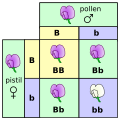 Punnett square showing Mendel's flowers
 -
 Example of autosomal dominant pedigree
 -
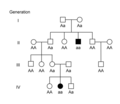 Example of autosomal recessive pedigree


Medical Disclaimer: WikiMD is for informational purposes only and is not a substitute for professional medical advice. Content may be inaccurate or outdated and should not be used for diagnosis or treatment. Always consult your healthcare provider for medical decisions. Verify information with trusted sources such as CDC.gov and NIH.gov. By using this site, you agree that WikiMD is not liable for any outcomes related to its content. See full disclaimer.
Credits:Most images are courtesy of Wikimedia commons, and templates, categories Wikipedia, licensed under CC BY SA or similar.
Translate page: - East Asian
中文,
日本,
한국어,
South Asian
हिन्दी,
தமிழ்,
తెలుగు,
Urdu,
ಕನ್ನಡ,
Southeast Asian
Indonesian,
Vietnamese,
Thai,
မြန်မာဘာသာ,
বাংলা
European
español,
Deutsch,
français,
Greek,
português do Brasil,
polski,
română,
русский,
Nederlands,
norsk,
svenska,
suomi,
Italian
Middle Eastern & African
عربى,
Turkish,
Persian,
Hebrew,
Afrikaans,
isiZulu,
Kiswahili,
Other
Bulgarian,
Hungarian,
Czech,
Swedish,
മലയാളം,
मराठी,
ਪੰਜਾਬੀ,
ગુજરાતી,
Portuguese,
Ukrainian

